For international travelers navigating departure terminals, the modern airport waiting lounge is defined by a rigid, unspoken choreography: individual passengers hunched over laptops in ergonomic armchairs, travelers nursing expensive coffees at café high-tops, and solitary commuters grabbing packaged sandwiches from duty-free kiosks.
On November 7, 2026, a viral video emerging from an airport in Vietnam shattered that sterilized routine, sending shockwaves across Indian social media and igniting an all-out cultural debate over civic decorum, communal dining traditions, and the realities of budget international travel.
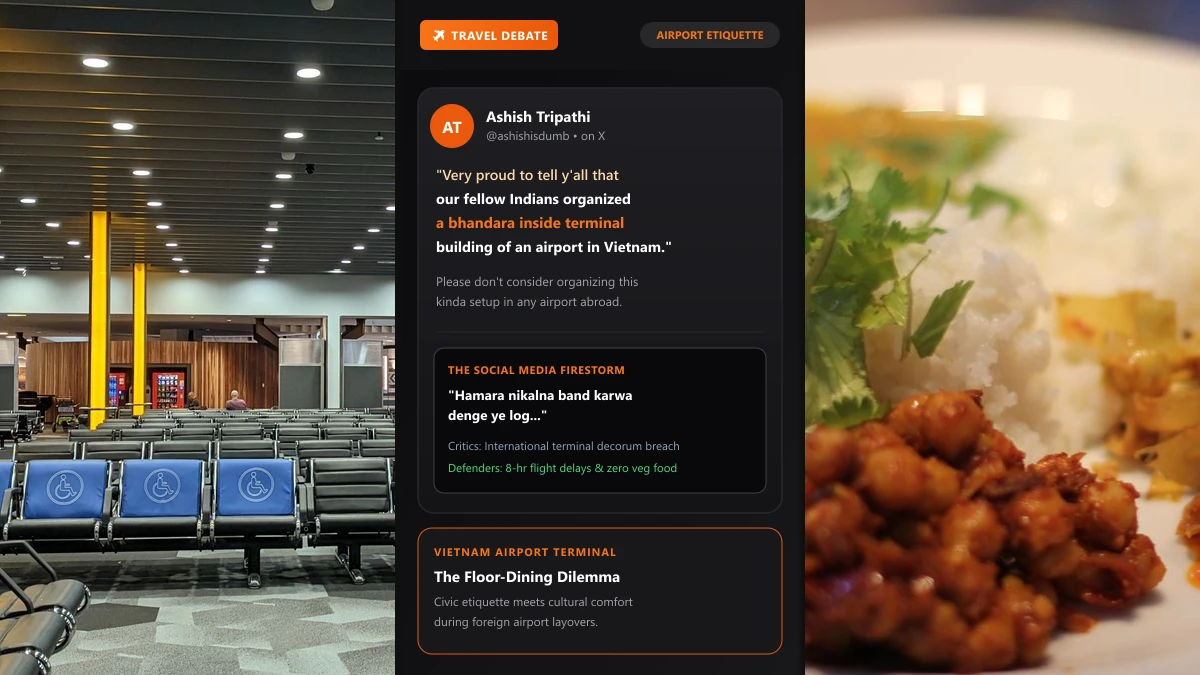
The footage, shared on X (formerly Twitter) by user Ashish Tripathi (@ashishisdumb), captures a large group of Indian holidaymakers who turned a polished airport departure terminal into an impromptu community feast—an arrangement netizens instantly recognized as an authentic Indian “bhandara.”
Very proud to tell y’all that our fellow Indians organized a bhandara inside terminal building of an airport in Vietnam. I would request everyone travelling abroad, please don't consider organizing this kinda setup in any airport.
— Ashish Tripathi (@ashishisdumb) November 7, 2026
@ashishisdumb) resharing footage originally documented by @Hrishukesh.Core Controversy: An extended Indian family tour group spreading newspapers across the terminal floor in a Vietnam airport, unpacking homemade meals, and conducting communal floor dining in a sterile international transit lounge.
In the video, over a dozen travelers—spanning elderly parents, working adults, and young children—sit cross-legged directly on the terminal’s shiny tiled floor. Spread neatly before them are sheets of newspaper acting as makeshift tablecloths, stacked high with foil-wrapped theplas, homemade parathas, plastic containers of pickles, and dry snacks. As the camera pans across the gathering, several men in the group smile broadly, chewing happily and waving warmly at the lens, completely oblivious to the bewildered stares of foreign transit passengers walking past.
The Online Firestorm: “Hamara Nikalna Band Karwa Denge Ye Log”
Within hours of being posted, the clip racked up hundreds of thousands of views and triggered a ferocious war of words in the comments.
For a large segment of Indian netizens, the visual evoked visceral embarrassment. Critics argued that treating an international airport terminal like an unreserved railway coach or a highway dhaba compromises the global standing of Indian travelers:
- “Hamara nikalna band karwa denge ye log… poore duniya mein desh ko badnaam karo,” vented one commenter, echoing the collective anxiety of young Indian globetrotters who fear tightened visa scrutiny and stereotyping abroad.
- “Airports have strict safety codes. Spreading food on the terminal floor creates slipping hazards from spilled oils, blocks passenger thoroughfares, and invites pest control issues,” noted an aviation consultant on X. “There are designated food courts and tables for a reason.”
- “Civic sense is not optional just because you are in a group. Why can’t we adapt to global public space etiquette when traveling overseas?” asked another widely upvoted response.
The incident struck an especially sensitive nerve because it follows a string of previous viral embarrassments involving Indian tourist groups in Vietnam. Just months earlier, another video sparked widespread ridicule after a tour group formed a raucous circle and performed loud Garba dances right on a Vietnam airport tarmac next to passenger boarding stairs, completely ignoring tarmac safety protocols.
The Counter-Perspective: Flight Delays, Empty Wallets, and the Vegetarian Desert
However, as the backlash mounted, a vocal contingent of seasoned travelers stepped forward to vigorously defend the family, pointing out the harsh, unglamorous realities of budget Southeast Asian travel that social media critics often overlook.
Their defense centered on three practical dilemmas:
1. The Southeast Asian “Dietary Desert”
For strict lacto-vegetarian, vegan, or Jain travelers from India, traveling in Vietnam can be an agonizing culinary ordeal. Vietnamese gastronomy is heavily reliant on pork bone broth, fish sauce (nước mắm), shrimp paste, and animal fats. Even seemingly benign noodle dishes like Pho Chay or vegetable spring rolls often use shared cookware or broths flavored with dried seafood.
Past the security gates in secondary Vietnamese airports (such as Da Nang, Nha Trang, or Phu Quoc), terminal dining is dominated by Western fast food chains (Burger King, Popeyes) and local meat soup stalls. Finding a clean, vegetarian meal that complies with religious dietary restrictions is virtually impossible. For an elderly vegetarian couple traveling for 12 hours, packed theplas and mathris are not a casual snack—they are a survival necessity.
2. Chronic Seating Deficits During Budget Flight Delays
Secondary international terminals across popular tourist corridors frequently suffer from severe infrastructure bottlenecks. When multiple low-cost carrier flights (such as VietJet or AirAsia) experience cascading rolling delays of 5 to 8 hours, terminal gate areas become completely overwhelmed.
Dozens of defenders highlighted that when every metal gate chair is occupied, sitting on the floor is standard practice for travelers of all nationalities across European and Asian airports.
3. Respectful Cleanliness Over Raucous Disruption
Unlike unruly groups that leave trash strewn across public seats, defenders pointed out that the tourists in the video deliberately laid down newspapers to prevent any food crumbs or oil from touching the airport tiles.
“They didn’t break anything, they didn’t scream, and they didn’t harass anyone,” argued one supporter on X. “They are a family sharing a simple meal on newspapers during a long layover. White backpackers sleep barefoot across terminal floors and get called ‘free-spirited’, but Indian families sharing home-cooked food get labeled uncivilized.”
The Deeper Cultural Tension: “Pangat” vs. Western Individualism
Beyond the immediate social media brawl, the controversy exposes a fascinating sociological clash between contrasting definitions of public space.
In Indian cultural heritage, communal eating is rooted in the sacred concept of the pangat—sitting in a line on the floor to share food without hierarchy. Dining is an inherently collective, warm, and egalitarian act. Refusing to eat in front of family members or isolating oneself with an expensive solo meal is seen as antithetical to family bonding.
Conversely, modern global aviation hubs are architecturally constructed around Western individualism and hyper-commercialization. In these spaces, food consumption is intended to be individualized, transaction-based, and confined to partitioned commercial zones. When a high-context communal culture operates inside a low-context corporate infrastructure, friction is inevitable.
The Changing Demographic of Global Travel
The Vietnam airport incident highlights the seismic shift occurring in Indian outbound tourism.
Spurred by direct budget flight routes from cities like Ahmedabad, Kochi, and Lucknow, simplified e-visas, and affordable currency conversion rates, international travel is no longer the exclusive playground of India’s Westernized elite. Millions of middle-class families, small business owners, and first-time travelers from tier-2 and tier-3 towns are venturing abroad for the very first time.
These travelers carry their traditional values, dietary requirements, and collective family habits with them wherever they go. While learning the nuances of international airport regulations—keeping walkways clear, utilizing designated dining tables, and respecting shared public decorum—is an essential rite of passage for any traveling community, the viral video serves as a reminder that empathy, infrastructure planning, and cultural awareness must go both ways.
As one thoughtful netizen concluded: “Civic sense should always be taught and practiced. But before you publicly shame your own people for sharing a meal on a newspaper, ask yourself if the airport offered them a single seat or a single plate of food they could eat.”