On the evening of Sunday, November 8, 2026, as millions of families across the National Capital Region (Delhi-NCR) gathered to illuminate earthen diyas and perform Diwali Lakshmi Puja, the festive air was charged with a distinctly modern urban tension. In towering gated condominiums stretching across Noida, Greater Noida, and Gurugram, celebration did not collide with quiet reverence—it collided with the ironclad mandates of judicial benches, high-rise building bylaws, and ferocious debates inside housing society WhatsApp groups.
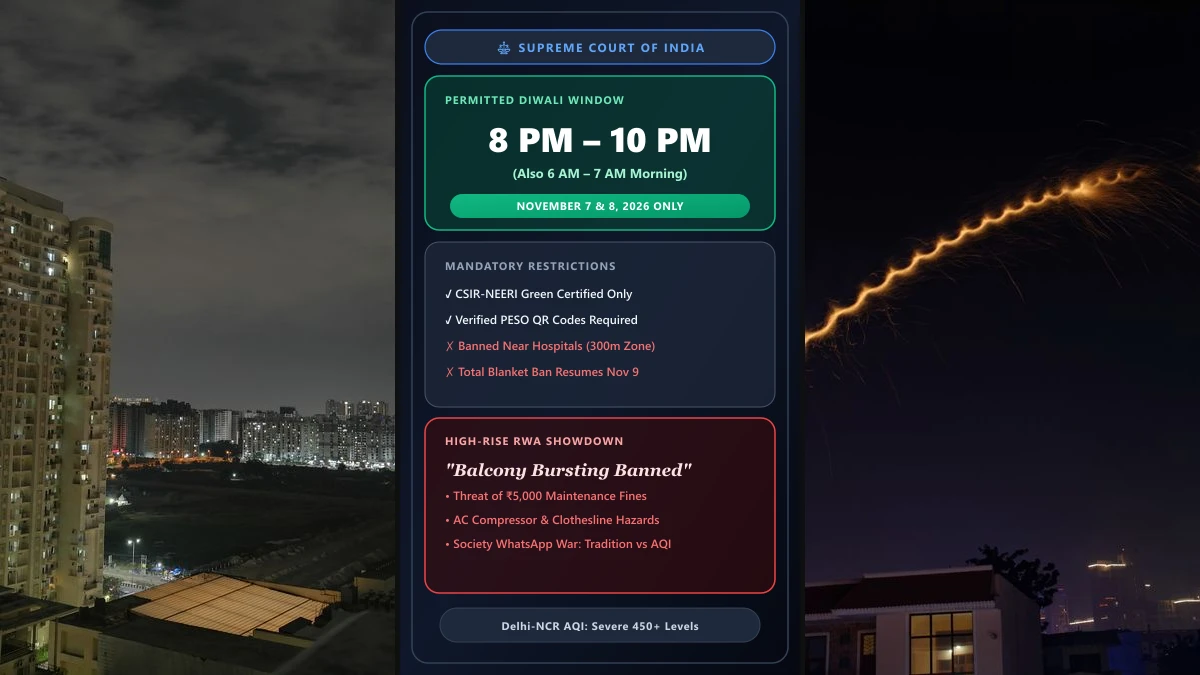
The friction stemmed from the Supreme Court of India’s highly calibrated festive order for Diwali 2026. Striking a delicate balance between public health and religious tradition, the apex court permitted the sale and bursting of certified green firecrackers exclusively during a narrow two-hour evening window—from 8:00 PM to 10:00 PM on November 7 and 8—alongside a secondary morning slot from 6:00 AM to 7:00 AM. But when that order met the reality of dense vertical townships housing thousands of families within a single complex, managing committees reacted with emergency crackdowns.
"Supreme Court allows certified green crackers in Delhi for Diwali... limited to designated morning and evening hours on November 7 and 8, but how will RWAs and police actually enforce this in packed societies?"
Supreme Court Allows Certified Green Crackers In Delhi For Diwali
by u/VCardBGone in delhi
Across major residential sectors—from Noida’s 7X sectors (Sectors 74 through 78) and Sector 137 on the Noida Expressway to Gurugram’s Golf Course Extension Road and Sohna Road—Resident Welfare Associations (RWAs) and Apartment Owners Associations (AOAs) inundated resident portals with unprecedented warnings: an absolute ban on bursting crackers from private balconies, threats of ₹5,000 maintenance penalties, and deployment of dedicated patrol teams armed with sound-level meters and fire extinguishers.
The High-Rise Balcony Hazard: Why Vertical Living Upended Diwali
In traditional low-rise colonies and independent bungalows, firecracker celebrations historically unfolded on spacious ground-level courtyards or wide colony streets. However, the rapid vertical expansion of Delhi-NCR over the past two decades has concentrated millions of residents into 25-to-35-story residential towers, fundamentally transforming the physics and safety of festive pyrotechnics.
When high-intensity fireworks are set off from cramped apartment balconies, standard safety margins vanish:
- The Projectile Risk: Multi-shot aerial cakes, rockets, and whistling roman candles launched horizontally from an 8th-floor or 15th-floor balcony do not soar harmlessly into open clouds. Instead, wind gusts frequently steer burning embers directly into neighboring apartments across the courtyard, landing on laundry clotheslines, cardboard delivery boxes, and artificial balcony turf.
- The AC Compressor Threat: In modern high-rise architecture, external air conditioning compressor units are mounted directly on balcony ledges or service shafts. These units contain pressurized flammable refrigerants and plastic casing; a single stray spark can ignite an electrical or chemical blaze that spreads through common duct shafts before municipal fire tenders can navigate podium ramps.
- Falling Shrapnel & Debris: Heavy cardboard tubes, hot plastic plugs, and metallic sparkler rods discarded from upper balconies accelerate at terminal velocity, posing severe head injury risks to pedestrians and parked vehicles on ground-level podiums below.
Recognizing these acute hazards, managing committees took a zero-tolerance stance. In society notices issued across Noida Sector 76, RWAs informed residents that common security cameras would be monitored live throughout the 8:00 PM to 10:00 PM window. Any household identified launching projectiles from private balconies or utility ledges faced instant fines added directly to their monthly maintenance bills, alongside forfeiture of clubhouse privileges and reporting to local police patrolling units.
The Society WhatsApp War: Festive Tradition vs The Right to Breathe
The arrival of the RWA circulars set off immediate digital fireworks inside society community forums and resident WhatsApp groups, illustrating a deep cultural divide in modern urban neighborhoods.
The community split into two passionate camps:
- The Festive Traditionalists: Many residents argued that Diwali occurs only once a year and that families should not be subjected to institutional micromanagement within their own private residences. Parents expressed frustration that taking excited young children down crowded elevator banks to small, designated podium patches dampened the spontaneous magic of the festival. Others pointed out that since the Supreme Court had explicitly legalized certified green crackers for two hours, housing societies had no legal standing to impose total balcony prohibitions.
- The Health Advocates & Vulnerable Groups: Conversely, families with newborn infants, elderly cardiac patients, and household pets rallied staunchly behind the RWA restrictions. With Delhi-NCR’s Air Quality Index (AQI) already hovering in the Severe zone between 420 and 480, particulate matter concentrations inside non-air-purified rooms were already hazardous. For these residents, dense smoke trapped between closely spaced concrete towers creates a toxic chimney effect, forcing asthmatic occupants to seal every window behind air filters.
The tension also exposed underlying friction between resident flat owners and younger tenant communities. In several high-end condominiums along Gurugram’s Golf Course Extension Road, managing committees warned that tenant violations would be escalated directly to property owners with requests for lease termination, prompting accusations of discriminatory heavy-handedness.
The Science & Chemistry of “Green Crackers”: What NEERI Formulas Do
Central to the Supreme Court’s calibrated two-hour window is the technological promise of “green crackers”—formulations developed by the Council of Scientific and Industrial Research - National Environmental Engineering Research Institute (CSIR-NEERI).
Unlike conventional fireworks that have dominated Indian markets for decades, certified green crackers replace toxic chemical binders with innovative, eco-friendlier formulations:
- SWAS (Safe Water Releaser): These crackers eliminate sulfur and potassium nitrate, utilizing a specialized chemical matrix that releases microscopic water vapor upon ignition. The released moisture immediately dampens dust particles, suppressing airborne soot.
- STAR (Safe Thermite Cracker): Formulated without potassium nitrate or sulfur, STAR crackers utilize lower-energy oxidizers that significantly cut down on toxic smoke plume generation.
- SAFAL (Safe Minimal Aluminum): Replaces substantial portions of volatile aluminum powder with magnesium, resulting in lower flash heat and substantially reduced gaseous emissions.
From a regulatory and scientific perspective, authentic green crackers provide measurable environmental improvements:
- Particulate Emission Reduction: They reduce particulate matter (PM2.5 and PM10) emissions by approximately 30% to 35% compared to traditional gunpowder compositions.
- Noise Suppression: Acoustic thresholds are restricted to 90 to 105 decibels (dB), a significant decrease from conventional firecrackers that frequently exceeded 125 dB.
- Zero Barium Nitrate: Certified formulas completely ban barium salts—the chemical historically responsible for bright green sparkles, known to cause severe respiratory irritation and cardiac stress.
However, environmental scientists emphasize the crucial difference between “less polluting” and “non-polluting.” While a single green cracker emits 30% fewer particulates, bursting hundreds of thousands of them within a dense, landlocked geographical basin during an atmospheric winter temperature inversion still delivers an enormous toxic load. In stagnant meteorological conditions where surface wind speeds drop below 5 km/h, the collective smoke cannot disperse, inevitably pushing local PM2.5 readings past 600 to 800 µg/m³ in the hours following the permitted window.
Compounding the crisis is the widespread prevalence of counterfeit packaging. Enforcement squads in Delhi-NCR discovered illegal traders packaging traditional, barium-laced fireworks into counterfeit boxes stamped with forged NEERI logos and non-functioning QR codes, leaving everyday consumers unable to verify whether their festive purchases are truly compliant.
The Legal Showdown: Article 21 vs Article 25
The controversy over the two-hour green cracker window reflects a decade-long constitutional debate adjudicated by the Supreme Court of India.
The legal battle pits two fundamental constitutional guarantees against one another:
- Article 21 (The Right to Life and Clean Health): Multiple landmark Supreme Court rulings, including observations by benches led by Justice Abhay S. Oka, have established that the right to breathe clean, unpolluted air is an inalienable component of the Right to Life under Article 21. The judiciary has repeatedly affirmed that no commercial or cultural interest can supersede public health, particularly when toxic air endangers children, senior citizens, and vulnerable pulmonary patients.
- Article 25 (The Freedom of Conscience and Religious Practice): Proponents of firecracker celebrations have argued that lighting pyrotechnics during Diwali is an integral, centuries-old religious expression protected under Article 25.
By crafting the strict two-hour window for November 7 and 8, the Supreme Court sought a judicial middle path: rejecting an absolute blanket ban that drove sales entirely into an unregulated black market, while refusing unfettered commercial deregulation that would paralyze public healthcare infrastructure.
Crucially, the court emphasized that this festive dispensation is strictly temporary. Starting at 12:01 AM on Monday, November 9, 2026, the total blanket prohibition on the manufacture, storage, transport, sale, and bursting of any firecrackers snaps back into full legal force across the entire National Capital Region.
The Changing Social Contract of Modern India’s Celebrations
As the clock struck 10:00 PM on Diwali night, the rapid flurry of cracker bursts in high-rise corridors subsided under the watchful gaze of estate guards, CCTV cameras, and local police cruisers patrolling society boundary walls.
The intense debate over the Supreme Court’s two-hour window highlights a profound, permanent shift in India’s festive social contract. In the vertical megacities of the 21st century, individual celebratory choices can no longer be decoupled from shared communal consequences. Whether through synchronized community fireworks in central parks, laser and drone light spectacles, or returning to quiet earthen lamps along balconies, residents of Delhi-NCR are discovering that preserving centuries of cultural heritage requires adapting to the modern physical boundaries of the towers they call home.