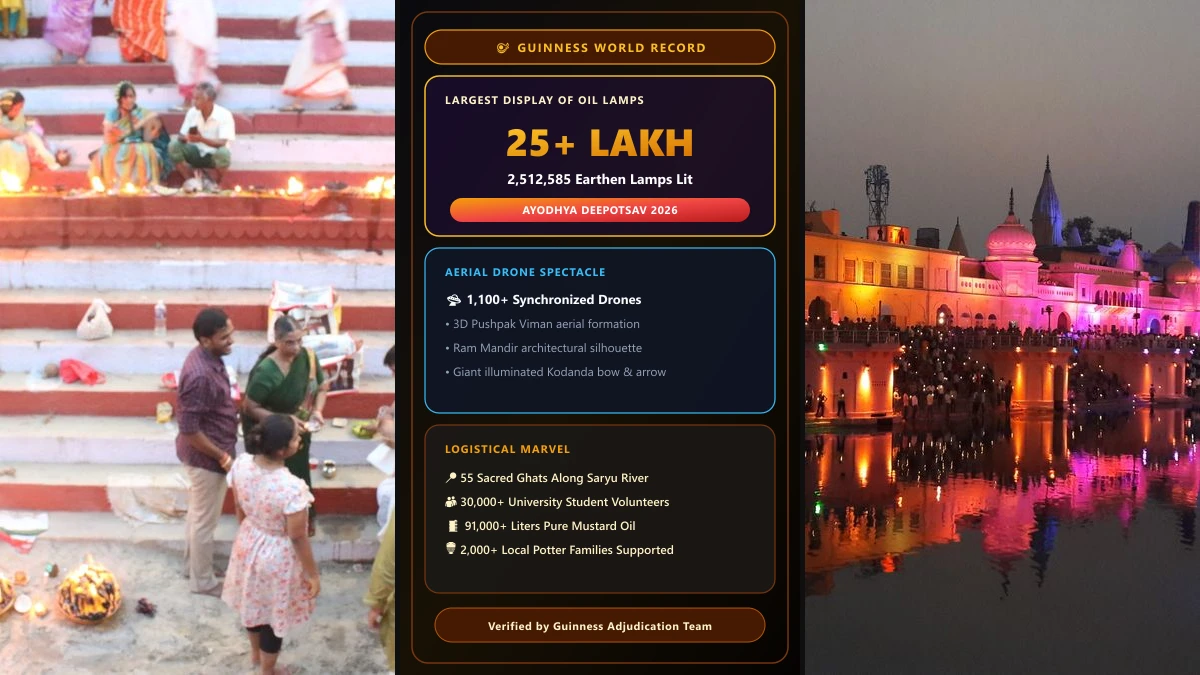
On the sacred evening of Sunday, November 8, 2026, as the country celebrated Diwali, the ancient riverbanks of Ayodhya were transformed into a celestial ocean of golden light. Across 55 historic stone ghats hugging the serpentine bends of the holy Saryu River—anchored by the tiered steps of Ram Ki Paidi—more than 25 lakh handcrafted earthen lamps (diyas) flickered into synchronized radiance, shattering previous global benchmarks and etching the holy city’s name into international record books once again.
The grand illumination, executed during the milestone edition of Ayodhya Deepotsav, officially secured two Guinness World Records on site. Adjudicators from Guinness World Records verified an astonishing 2,512,585 earthen lamps burning simultaneously for over five uninterrupted minutes, marking the largest display of oil lamps anywhere on Earth. Minutes earlier, a secondary world record was achieved when 1,121 devotees and priests performed a synchronized mass Saryu Aarti along the water’s edge, creating an ethereal spectacle that captivated millions watching live broadcasts across the globe.
"Ayodhya creates history once again: over 25 lakh earthen lamps illuminate 55 ghats along the sacred Saryu River, officially verified by Guinness World Records as the largest display of oil lamps on Earth."
As darkness descended over Ram Katha Park and Ram Ki Paidi, the golden glow of the riverbanks was mirrored by a stunning technological feat above: a synchronized fleet of over 1,100 indigenous drones performing dynamic 3D light choreographies across the night sky, weaving ancient epic narratives into cutting-edge aerial robotics.
The Logistics & Mathematical Precision Behind 25 Lakh Lamps
Illuminating over two and a half million earthen lamps on open stone riverbanks is not merely a spiritual ritual; it represents one of the most intricate civilian logistical operations mounted in modern India.
To satisfy the stringent audit requirements mandated by Guinness World Records adjudicators, the event organizers instituted rigorous scientific protocols months ahead of Diwali:
- The Geometric Grid System: Across all 55 ghats, the stone steps were measured and chalked into precise geometric matrices. The primary building blocks consisted of 16×16 grids (containing exactly 256 diyas) and 14×14 grids (containing 196 diyas). This modular layout allowed supervisory teams to track exact lamp counts through automated aerial photographic mapping.
- 91,000+ Liters of Cold-Pressed Mustard Oil: To ensure a clean, continuous burn without thick chemical soot, over 91,000 liters of pure mustard oil were distributed in measured food-grade jerrycans across the ghats. Each lamp was filled to a calibrated level to sustain a minimum burn time of 40 minutes.
- 30,000+ Student Volunteers: The physical backbone of the operation comprised more than 30,000 student volunteers mobilized from Dr. Ram Manohar Lohia Avadh University, 14 degree colleges, and affiliated National Cadet Corps (NCC) and National Service Scheme (NSS) units. Divided into sector teams, each volunteer was assigned responsibility for 85 to 100 lamps, ensuring rapid, synchronized lighting before the official audit window opened.
- Aerial Thermal & Optical Verification: Rather than relying on manual headcounts, Guinness adjudicators deployed high-definition camera drones equipped with optical zoom and thermal sensors. Hovering over the Saryu River, the automated system scanned each designated grid to verify that at least 80% of the lamps were actively burning at the designated audit moment.
When the final tally was confirmed at 2,512,585 lamps, the adjudicators officially handed the Guinness World Records certificate to Uttar Pradesh Chief Minister Yogi Adityanath amidst resounding conch shells and chants of “Jai Shri Ram.”
The Aerial Drone Ballet: 1,100 Drones Over the Saryu River
While the ghats glowed with the warm amber light of clay and oil, the night sky directly above the Saryu River became the canvas for a breathtaking 15-minute aerial drone show.
Choreographed using an indigenous swarm of over 1,100 high-precision UAVs (unmanned aerial vehicles), the aerial fleet utilized differential GPS waypoints and multi-colored LED arrays to paint three-dimensional spatial animations against the pitch-black sky:
- The Return on the Pushpak Viman: The show commenced with a 150-meter-wide celestial chariot gliding gracefully above the river, depicting the legendary return of Lord Ram, Sita, and Lakshman to Ayodhya after 14 years of exile.
- The Mythical Kodanda Bow: In one of the most captured viral moments on social media, the drone swarm reorganized into an immense golden archer drawing the celestial Kodanda bow, releasing an animated flaming arrow that traced a glowing 200-meter trajectory across the riverfront.
- The Architectural Silhouette of Ram Mandir: The aerial ballet culminated in a photorealistic 3D light rendering of the newly consecrated Ram Janmabhoomi Mandir, complete with towering shikhara spires and glowing lotus motifs, eliciting thunderous cheers from hundreds of thousands of spectators packing the opposite riverbanks.
The drone spectacle was seamlessly synchronized with ground-level laser mapping projected onto the heritage facades of Ram Ki Paidi, accompanied by an orchestral symphony composed of traditional Indian instruments—shehnai, mridangam, and sitar—mixed with contemporary cinematic acoustics.
The Rural Economy & The Kumhar (Potter) Revival
Beneath the grandeur of global records and high-tech aerial displays lies a profound, transformative economic engine that breathes life into Uttar Pradesh’s rural artisanal heartland.
In an era where mass-produced, non-recyclable plastic LED string lights and toxic chemical novelties have heavily displaced traditional festival crafts, Deepotsav has single-handedly revived the ancient pottery craft (kumhari) across northern India:
- Livelihood for 2,000+ Potter Families: Preparing 25 lakh earthen lamps is a multi-month endeavor that begins as early as July. Over 2,000 rural artisan families across Ayodhya, Basti, Ambedkar Nagar, and Gorakhpur are engaged through guaranteed government procurement contracts, providing vital seasonal income that sustains households for the entire year.
- Zero-Carbon Ecological Footprint: Unlike synthetic fireworks or chemical decorations, traditional earthen lamps are entirely eco-friendly. Sourced from local alluvial riverbed clay, the diyas are sun-baked and fired in community kilns. After the festival, the biodegradable clay dissolves naturally back into the soil and riverbed silt without leaving toxic chemical residues.
- The Sustainable Oil Recovery Protocol: In alignment with environmental guidelines, municipal authorities and agricultural self-help groups initiated a zero-waste cleanup protocol immediately following the celebrations. Leftover unburnt mustard oil is collected from the ghats and repurposed by bio-fuel and organic soap-making enterprises, while the spent cotton wicks are gathered for compost production.
Cultural Evolution: From Local Revival to Global Benchmark
When the inaugural edition of Deepotsav was conceived in 2017, the event began on a relatively modest scale, lighting approximately 1.71 lakh diyas. Over the subsequent nine years, the festival has grown exponentially, setting new world records almost annually: 3.01 lakh in 2018, 4.04 lakh in 2019, 6.06 lakh in 2020, 9.41 lakh in 2021, 15.76 lakh in 2022, 22.23 lakh in 2023, and culminating in the historic 25.12+ lakh milestone today.
This steady evolution reflects a deeper cultural resonance. In the collective consciousness of India, Diwali marks the homecoming of Lord Ram to an illuminated, joyous Ayodhya. By staging this celebration at a monumental, record-setting scale, the holy city has reimagined its foundational myth as a public cultural benchmark that commands global attention.
As midnight approached and the flickering diyas cast long golden reflections across the waters of the Saryu River, the scene stood in serene contrast to the noisy, smoke-choked streets of modern industrial cities. Ayodhya’s record-breaking Deepotsav offered a timely reminder of what Diwali was always meant to be: a quiet, awe-inspiring victory of light over darkness, celebrated through human harmony, traditional craftsmanship, and shared communal joy.