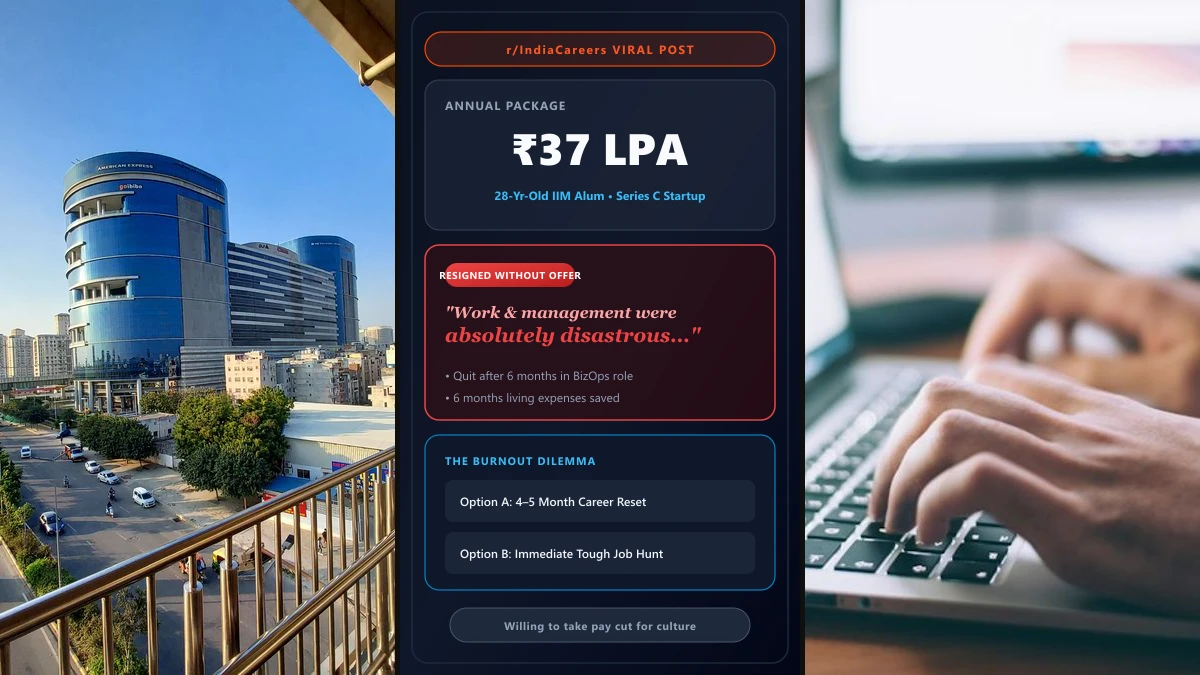
In the hyper-competitive corridors of India’s premier management institutions, landing an annual package exceeding ₹35 lakh per annum (LPA) before turning thirty is widely celebrated as the ultimate gold standard of early-career success. For thousands of aspiring MBA graduates grinding through 16-hour study routines, such compensation packages represent financial independence, social prestige, and entry into the elite decision-making layers of the modern tech ecosystem. Yet behind the gilded salary slips and glossy LinkedIn updates, an escalating crisis of executive chaos, non-existent work-life boundaries, and psychological exhaustion is driving high-earning young leaders to make unthinkable choices.
That brewing corporate tension erupted into a viral national debate this week after a 28-year-old alumnus from one of the country’s top Indian Institutes of Management (IIM ABC) took to Reddit’s r/IndiaCareers community. Writing under the handle u/Fast-Text-6809, the young professional announced that he had officially tendered his resignation from a high-profile ₹37 LPA internal strategy and business operations role at a Series C technology startup—without securing another employment offer or backup plan.
"37LPA - Resigned without offer, should I take a break or start looking immediately? ... joined a Series C startup 6 months ago after moving out of consulting. My experience here has been absolutely disastrous with both the work and the senior management."
37LPA - Resigned without offer, should I take a break or start looking immediately?
by u/Fast-Text-6809 in IndiaCareers
Describing his six-month tenure as “absolutely disastrous,” the employee revealed that deep-seated disillusionment with the startup’s senior management and chaotic operational direction had forced him to pull the plug, despite having only his final week left to serve. With roughly six months’ worth of living expenses saved in his bank account, the professional found himself paralyzed at a career crossroads: should he immediately throw himself back into the unforgiving 2026 hiring gauntlet, or take a deliberate four-to-five-month sabbatical to preserve his mental health—even if it meant accepting a pay cut down the road?
The Mathematics of a ₹37 LPA Package & The 6-Month Liquid Runway
To understand why walking away from a ₹37 LPA package created such intense shockwaves across Indian professional forums, one must look at both the financial structure and the steep cost of white-collar urban survival in tech hubs like Bengaluru, Gurugram, and Mumbai.
In contemporary Indian startup compensation architectures, an overall Cost-to-Company (CTC) quote of ₹37 LPA rarely translates into equal monthly cash disbursements. Typically, such packages are carved into multiple tiers:
- Fixed Base Component: Approximately ₹26 lakh to ₹28 lakh annually.
- Performance Bonus / Variable Pay: Typically 10% to 15% (₹3.5 lakh to ₹4.5 lakh), contingent on aggressive company-level growth targets and discretionary executive reviews.
- ESOPs & Retention Tranches: The remaining balance often consists of Employee Stock Ownership Plans with multi-year vesting schedules, holding zero immediate liquidity until secondary buybacks or future funding rounds.
After factoring in standard tax deductions, mandatory Provident Fund contributions, and the highest 30% Tax Deducted at Source (TDS) slab, an executive at this bracket pockets an in-hand monthly salary between ₹1.85 lakh and ₹2.10 lakh. While undeniably a top-tier income for a 28-year-old, living in major corporate corridors imposes heavy baseline expenses. Rent for a modest 1BHK or 2BHK flat near key tech clusters—such as Gurugram’s Golf Course Extension Road or Bengaluru’s Outer Ring Road—ranges between ₹40,000 and ₹60,000 per month, plus maintenance fees, daily transit, groceries, and domestic utilities.
According to the author, his personal savings pool could comfortably sustain his urban rent and recurring living expenses for exactly six months without any incoming revenue. However, embarking on a four-to-five-month career pause would deplete anywhere from 70% to 85% of his liquid emergency reserve. That reality poses a dangerous mathematical gamble in an unpredictable macroeconomic climate, leaving almost zero buffer for unexpected family emergencies or protracted interview pipelines. Recognizing this vulnerability, the IIM graduate made an unusual concession: he explicitly noted that he would willingly accept a substantial salary reduction in his next role if the organization provided genuine psychological safety, transparent leadership, and sustainable operating hours.
The Consulting-to-Startup Churn: Anatomy of a Disillusionment
The professional’s trajectory illustrates a classic dilemma increasingly felt across India’s managerial elite: the abrupt culture shock of transitioning from structured management consulting to the volatile belly of growth-stage tech startups.
Prior to entering the Series C startup, the author worked as a strategy consultant at a Tier-2 firm. In corporate consulting, professionals endure notoriously grueling project timelines, but they operate within established analytical frameworks, clear deliverable scopes, and robust project governance backed by partners who shield teams from client tantrums.
When high-growth venture-backed startups raise Series B and Series C rounds, they aggressively recruit ex-consultants and elite MBA graduates to build out internal “Founder’s Office,” “Corporate Strategy,” and “BizOps” teams. These roles are pitched with enticing promises of high executive visibility, autonomous operational ownership, and strategic directorship.
In practice, however, many Series C tech scale-ups struggle with operational adolescence:
- The “Growth at All Costs” Squeeze: Startups facing aggressive venture capital milestones frequently pivot operational goals on a weekly basis, discarding months of analytical work overnight.
- Lack of Operating Procedures (SOPs): Unlike institutional consulting firms or multinational corporations, fast-scaling startups often lack documented workflows, turning routine cross-functional handoffs into daily turf wars.
- Executive Whims & 24/7 Pinging: Senior management in early-to-mid stage ventures often operate with unstructured hierarchies, expecting senior associates to answer midnight WhatsApp messages, attend Sunday evening syncs, and resolve basic operational fires that have little to do with actual business strategy.
For a strategy specialist accustomed to data-driven decision-making, discovering that daily duties consist of mediating founder conflicts, managing chaotic executive moods, and executing contradictory directives creates rapid cognitive dissonance. When the author characterized his six-month tenure as “disastrous,” he gave voice to an entire demographic of young Indian professionals who realize that prestige titles in chaotic tech ventures often mask acute organizational dysfunction.
Community Debate: “First-World Problem” vs The “Resume Gap” Penalty
Within hours of publication, the Reddit thread evolved into an expansive referendum on corporate burnout, financial security, and career survival. The community split sharply into two vocal factions: those who viewed the resignation as an enviable display of privilege, and veteran professionals who urged extreme caution in the face of brutal industry headwinds.
The initial wave of commentary reflected widespread skepticism regarding the author’s privileged predicament. One user encapsulated this sentiment bluntly:
“Seems like a first-world problem. Everyone on Reddit seems to be earning 30+ LPA at 27 and conveniently resigns without any offer.”
Critics argued that being able to walk away from a ₹37 LPA job with half a year of living expenses in the bank is a luxury unavailable to 99% of India’s workforce, where entry-level IT services salaries have remained stubbornly fixed between ₹3.5 LPA and ₹4.5 LPA for over a decade.
However, seasoned corporate leaders and IT veterans offered a far more sobering perspective on the cold realities of the current job market:
- The Brutal 2026 Hiring Slowdown: Commenters noted that white-collar tech hiring across India has tightened substantially following widespread global restructuring. At senior compensation brackets (₹35+ LPA), available openings are scarce, and each vacancy attracts hundreds of qualified candidates from recent tech layoffs.
- The “Immediate Joiner” Negotiation Penalty: While Indian recruiters frequently covet candidates who can join without serving lengthy notice periods, being unemployed completely undermines an applicant’s bargaining leverage. Talent acquisition teams routinely capitalize on an applicant’s lack of alternative offers to pitch severe pay cuts.
- The Automated Resume Gap Filter: Automated Applicant Tracking Systems (ATS) and traditional HR departments in conservative Indian conglomerates often flag employment gaps exceeding three months, forcing candidates to repeatedly justify their hiatus in early interview screens.
One IT veteran with eight years of industry experience shared their own experience of resigning cold turkey, warning that landing a subsequent position required submitting over 100 applications and clearing 11 separate interview rounds over several grueling months.
Conversely, fellow alumni from top business schools rallied behind the author’s decision, emphasizing that interviewing while experiencing severe workplace depression often leads to catastrophic performance. Attempting case interviews, strategic evaluations, and leadership screenings with depleted mental reserves frequently results in repeated rejections, compounding emotional fatigue.
The Notice Period Conundrum & The Modern Search for Boundaries
The viral discussion also brought to the surface one of the most frustrating institutional bottlenecks in Indian corporate employment: the rigid 60-to-90-day notice period.
In most international tech hubs—including Silicon Valley, London, and Singapore—employment contracts standardly mandate two-to-four-week notice timelines, enabling professionals to comfortably interview, secure written offers, and transition smoothly. In India, however, employers routinely enforce 90-day lock-in periods to disincentivize attrition.
Because prospective employers rarely want to wait three months for a new hire to join, candidates are caught in an impossible Catch-22: recruiters refuse to interview them until they are on their final 30 days of notice, yet resigning without an offer feels terrifyingly reckless. For employees trapped in toxic or abusive management structures, enduring three full months of hostile working conditions while balancing secret interview schedules becomes an unmanageable psychological ordeal. Resigning first—despite the obvious financial hazards—is often the only viable escape hatch.
As the debate drew to a close, a pragmatic middle ground emerged from senior mentors on the forum:
- The “Micro-Break” Strategy: Rather than an open-ended four-month hiatus, take two to three weeks of complete digital detachment to travel, rest, and reset baseline sleep routines.
- Treating the Job Hunt as Structured Work: Dedicate a disciplined three to four hours each morning to professional outreach, prioritizing warm alumni networks and peer recommendations over passive portal applications.
- Setting Cultural Non-Negotiables: Use candidate questions during late-stage interviews to aggressively assess management style, cross-functional communication tools, and executive turnover before signing.
The overwhelming response to the IIM graduate’s dilemma underscores an undeniable transformation in India’s modern workplace ethos. Where previous generations endured toxic management, arbitrary hierarchies, and chronic overwork in pursuit of financial stability, India’s next generation of corporate talent is drawing a firm boundary: no compensation package, regardless of how many lakhs it promises on paper, is worth sacrificing one’s mental well-being and personal dignity.