In the high-stakes weeks leading up to Diwali, police departments across India mount intense enforcement drives to safeguard public safety, cracking down on dangerous fireworks, counterfeit explosives, and illicit noise-making contraptions. But in the historic city of Gwalior in northern Madhya Pradesh, an enforcement campaign collided head-on with algorithmic vanity when a uniformed police officer chose social media virality over departmental duty.
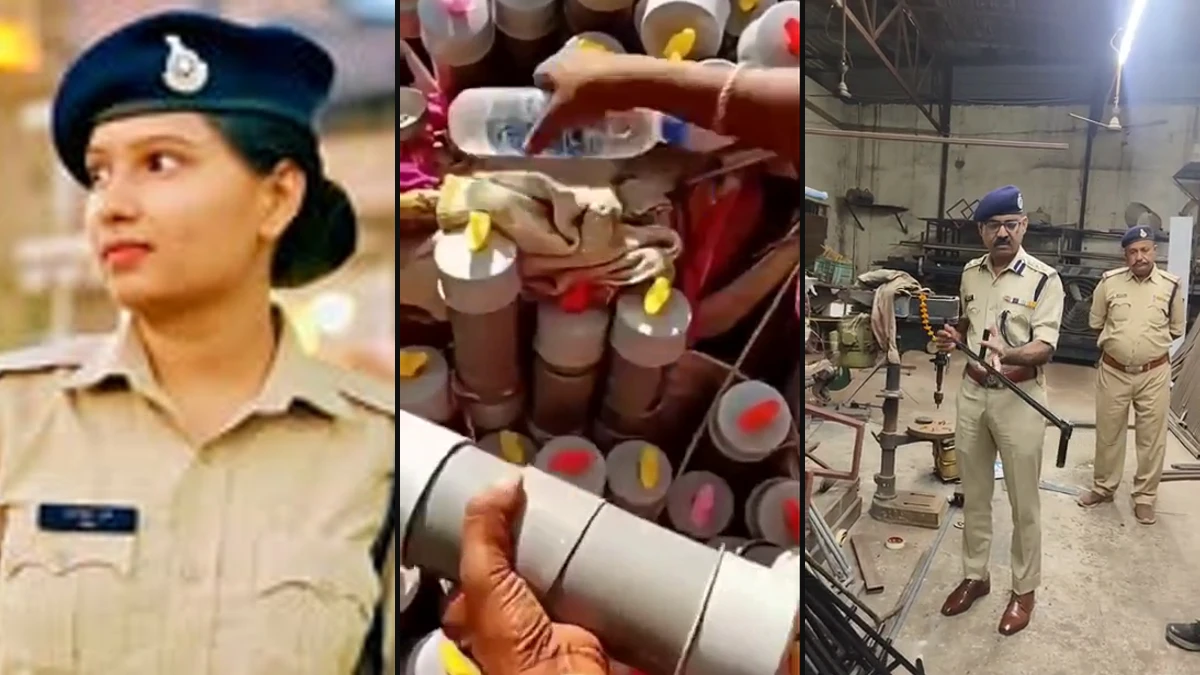
Kumkum Dubey, a female constable attached to the Kotwali Police Station in Gwalior, found herself placed under immediate administrative suspension after posting a viral Instagram reel demonstrating and firing a makeshift carbide gun. The incident triggered widespread embarrassment for the district police administration for a singular, inescapable reason: at the very moment the video surfaced, Gwalior police units were actively raiding clandestine workshops across the city to eradicate the exact same hazardous devices from civilian markets.
The Sudden Disciplinary Order from Police Headquarters
The viral video, which circulated widely across Instagram and local WhatsApp groups over 48 hours, showed the uniformed constable handling and firing the homemade pipe blaster. Within hours of the clip gaining traction, public comments began flagging the stark contradiction between the department’s stern public advisories and the officer’s casual celebration of the prohibited hardware.
Acting Superintendent of Police (SP) Shrutakirti Somvanshi immediately ordered a preliminary departmental investigation. Once investigators confirmed the authenticity of the recording and formally identified the protagonist as Constable Kumkum Dubey, the police leadership acted decisively. Somvanshi issued an order placing Dubey under immediate suspension and attaching her to the district Police Lines pending a full disciplinary inquiry.
Departmental spokespersons underscored that police personnel are sworn to uphold the highest benchmarks of discipline, conduct, and legal compliance. In uniform or out of uniform, promoting or operating contraband that the administration has officially outlawed represents conduct unbecoming of a member of the disciplined police force.
The Anatomy and Chemical Peril of Carbide Guns
To understand why law enforcement responded with such urgency, one must examine the mechanics of the so-called “carbide gun”—a dangerous festive trend that has proliferated across regional Indian markets over recent years.
Constructed from standard hollow PVC plumbing conduits or scrap metal piping measuring roughly two to three feet in length, these improvised cannons operate on a simple yet volatile chemical reaction:
- Chemical Loading: A small quantity of industrial-grade calcium carbide (CaC2)—a greyish solid chemical typically utilized in acetylene gas welding and fruit ripening—is placed into a sealed rear combustion chamber.
- Moisture Activation: The operator adds a few millilitres of water through a small aperture. The chemical reaction between calcium carbide and water instantaneously generates acetylene gas (C2H2) and calcium hydroxide:
CaC2 + 2 H2O → C2H2 + Ca(OH)2(In plain terminology: calcium carbide combined with moisture creates volatile, explosive acetylene fumes within seconds). - Ignition and Detonation: An integrated spark generator—often a modified piezo-electric kitchen gas lighter installed through the pipe endcap—ignites the trapped gas mixture.
Because acetylene possesses an exceptionally wide explosive flammability range (from 2.5% up to 82% air volume), the gas detonates with concussive force, producing a deafening, gunshot-like report and a sudden burst of flame from the open barrel.
+--------------------------------------------------------------------------+
|                  ANATOMY OF A MAKESHIFT CARBIDE BLASTER                  |
+--------------------------------------------------------------------------+
|  [OPEN BARREL] <==== Shockwave & High-Velocity Flame Burst               |
|         ||                                                               |
|  [PVC CONDUIT] ===== Brittle plastic chamber (prone to structural burst) |
|         ||                                                               |
|  [REAR SEAL]   ===== Calcium Carbide (CaC2) + Water Droplets             |
|         ||                                                               |
|  [SPARK PLUG]  <==== Piezo-Electric Gas Lighter (Instantaneous Flash)    |
+--------------------------------------------------------------------------+
|  Peril: Instant fragmentation into razor-sharp plastic shrapnel          |
+--------------------------------------------------------------------------+
While marketed surreptitiously to teenagers and children as an inexpensive alternative to commercial firecrackers—selling on street corners for merely ₹100 to ₹200—the physical realities are catastrophic. Unlike certified steel firearm chambers engineered to withstand high atmospheric pressures, commercial PVC plumbing pipes possess zero tensile tolerance for explosive shockwaves.
When excess carbide is loaded or the moisture balance is skewed, the pipe shatters into razor-sharp fragmentation shrapnel. During the previous festive season in 2025 alone, government eye hospitals across Madhya Pradesh recorded approximately 300 severe ocular blast trauma cases, including permanent corneal lacerations, partial blindness, and severe facial chemical burns.
The State Crackdown and Chief Minister’s Directives
The severity of the hazard led the state government to treat carbide guns not as mere festive mischief, but as prohibited explosive weaponry. Approximately two weeks prior to the incident, Madhya Pradesh Chief Minister Dr. Mohan Yadav convened a high-level video conference with divisional commissioners, district collectors, Inspectors General (IG), and district Superintendents of Police.
The Chief Minister issued strict directives mandating proactive pre-festive raids:
- Zero-Tolerance Ban: Total prohibition on the manufacture, retail stocking, sale, and public discharge of carbide pipe guns and uncertified chemical blasters.
- Weapons Classification: Invoking the provisions of the Explosives Act and regional Arms Act regulations against clandestine manufacturers and distributors.
- Aggressive Raids: Mobilizing special intelligence teams to inspect industrial supply shops, godowns storing calcium carbide without storage licenses, and backyard assembly units.
Following these state-level instructions, Gwalior police teams launched coordinated enforcement operations across the city, raiding workshops in Sirol, Ghasmandi, Transport Nagar, and Girwai. In multiple seizures leading up to Diwali, authorities confiscated over 645 kilograms of raw calcium carbide and seized dozens of finished pipe guns before they could reach neighborhood markets. Loudspeakers mounted on police interceptor vehicles traversed residential colonies, broadcasting warnings urging parents to confiscate any makeshift blasters from their children.
It was precisely this public outreach that transformed Constable Dubey’s social media reel into an administrative crisis. For the public, seeing a uniformed officer enthusiastically firing the exact weapon her department was campaigning against created a jarring disconnect between official policy and personal conduct.
Uniform vs Algorithm: The Law Enforcement Dilemma
The controversy in Gwalior reflects an intensifying dilemma facing police administrative bodies across India: the clash between institutional discipline and the allure of social media algorithms.
Over the past decade, short-form video platforms like Instagram Reels and YouTube Shorts have birthed a wave of “cop influencers”—younger police personnel seeking personal fame, digital validation, and follower counts by posting in uniform. While benign community engagement videos can humanize public servants, the line between constructive outreach and departmental misconduct is frequently crossed:
| Operational Parameter | Departmental Code of Conduct | Social Media Reel Culture |
|---|---|---|
| Primary Loyalty | Rule of law, public safety, institutional dignity | Algorithm engagement, virality, follower counts |
| Uniform Protocol | Symbol of state authority and neutral service | Aesthetic costume for cinematic dramatization |
| Contraband Handling | Evidence collection, legal seizure, secure custody | Dramatic prop for performance art |
| Public Messaging | Standardized, vetted safety advisories | Personal expressions, trending songs, and irony |
Police conduct regulations across Indian states explicitly forbid serving personnel from utilizing their official uniform, service credentials, or department weapons to produce commercial or entertainment content without prior written permission from the Director General of Police (DGP).
The Gwalior incident serves as a stern reminder of why these boundaries exist. When an individual takes the oath of public service and dons the khaki uniform, their personal social media presence ceases to be purely private—every post either reinforces or undermines public confidence in the rule of law.
Community Reaction and Administrative Precedent
Across social media platforms, reactions to the constable’s suspension split between sharp departmental criticism and satirical amusement. Many citizens commended acting SP Shrutakirti Somvanshi for taking swift, unambiguous action, noting that if ordinary shopkeepers face criminal charges for selling carbide blasters, law enforcement officers must be held to an even higher standard of accountability.
Others highlighted the sheer irony of the episode, pointing out that in an era where digital content creation has permeated every profession, institutional training must now include comprehensive digital ethics modules.
As the formal departmental inquiry into Constable Kumkum Dubey proceeds in Gwalior, the incident has set a clear precedent across Madhya Pradesh: festive safety directives apply equally to all citizens, and the badge provides no immunity from the consequences of chasing viral fame.