Every successful young Indian professional harbors a quiet, defining dream: the day they can finally hand their aging parents the keys to a grand, modern home. It is the ultimate badge of filial achievement—a tangible manifestation that all those late-night coding sprints, grueling corporate appraisals, or overseas postings in Oslo, London, or Seattle were worth the sacrifice. You buy the flat in a towering gated society with high-speed Italian elevators, manicured lawns, and biometric security, convinced that you have permanently delivered your parents from the inconveniences of their middle-class past.
And then reality strikes.
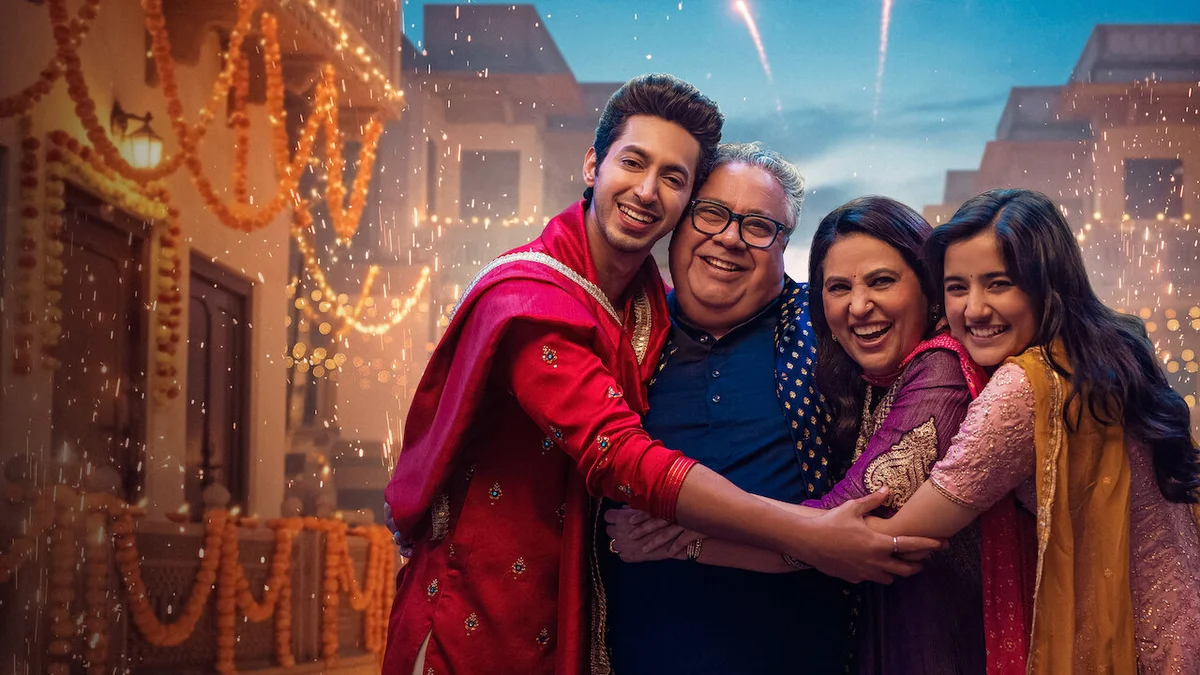
In Netflix’s festive family dramedy Dilwali Diwali—a 61-minute holiday special directed by Ritesh Menon, penned by Ritu Mago, and produced by Terribly Tiny Tales (TTT)—this exact intergenerational friction takes center stage. Released on November 5, 2026, the short feature has quietly transformed from a seasonal streaming drop into one of the most shared, debated, and emotionally resonant Indian films of the festive season. At its core is a deceptively simple, painfully hilarious premise: middle-class Punjabi parents who run an elaborate, covert operation to pretend they love their son’s luxury apartment, while secretly sneaking back to their old, noisy mohalla to actually live.
The Plot Catalyst: In Dilwali Diwali, Norway-based software engineer Ansh Sikka (Mihir Ahuja) gifts his parents a multi-crore, high-rise flat in an upscale Mumbai tower. But parents Sudhir (Manoj Pahwa) and Sukhi (Neelu Kohli) find the marble-clad apartment cold, sterile, and painfully lonely. Rather than break their proud son’s heart, they execute a weekly deception: living full-time in their creaky old colony house, and sprinting to the luxury flat only when Ansh initiates his scheduled WhatsApp video calls.
The comedy reaches fever pitch when Ansh decides to skip the transatlantic video routine and arrive unannounced on Diwali eve, setting off a frenzied, shoe-flinging race across town to stage the luxury flat before he unlocks the front door.
The Math of Modern Upgrades vs. The Currency of Community
The reason Dilwali Diwali has sparked such intense conversation across Indian internet communities—from threads on r/india and r/mumbai to corporate WhatsApp groups—is that almost every urban family has lived a version of this story. In India’s booming tier-1 metros, the economics of “upgrading” one’s parents have never looked shinier on paper, yet felt more hollow in practice.
Consider the financial benchmark of the modern Indian housing transition:
- The Gated High-Rise Equation: An entry-level 3BHK in a premium gated high-rise across Bengaluru’s Whitefield, Gurugram’s Golf Course Extension, or Mumbai’s suburban corridors regularly commands between ₹1.8 crore and ₹3.5 crore. On top of the mortgage, families shell out ₹10,000 to ₹18,000 per month in society maintenance fees for Olympic-sized swimming pools, squash courts, and co-working lounges that aging parents will likely never set foot in.
- The Social Deficit: In exchange for Italian marble, silent corridors, and CCTV coverage, parents are stripped of what sociologists term “horizontal social cohesion.” In a traditional DDA pocket, Mumbai chawl-turned-society, or independent Punjabi mohalla, social interaction has a zero marginal cost. The sabziwala yells his rates at 8:00 AM, the neighbor knocks without an appointment to borrow a katori of sugar, and evening conversations happen organically on shared boundary walls or street-corner benches.
- The Gated Enclosure Shock: In a modern 30-story tower, social interaction requires deliberate coordination. Doors remain double-locked behind heavy teak veneers. Corridors are whisper-quiet wind tunnels. Elevators operate on keycards. For a generation whose entire nervous system was calibrated to the background hum of community life, the luxury tower does not feel like an upgrade; it feels like an opulent open-air prison.
As veteran actor Manoj Pahwa brilliantly articulates through Sudhir’s quiet despair in the film, having four bathrooms and a modular German kitchen means very little when there is nobody outside the door to ask how your knee surgery is holding up.
The Internet Reacts: “My Parents Did The Exact Same Thing”
Following the film’s premiere, social feeds saw an outpouring of candid admissions from adult children who realized their own parents were quietly suffering through well-intentioned “lifestyle upgrades.”
On Reddit’s r/personalfinanceindia, one user shared a story that mirrored the plot of Dilwali Diwali almost beat for beat:
“I bought a 3BHK in a plush gated society in Sarjapur, Bengaluru, so my retired parents could move out of their 40-year-old independent house in Mysore. For six months, my dad kept telling me how amazing the clubhouse was. Then one weekend I visited unannounced and found my dad sitting down at the entry gate, sharing beedis and tea with the security guards on a plastic stool. He looked at me sheepishly and said, ‘Beta, upstairs nobody talks. At least here someone speaks Kannada.’ We sold the flat within a year and sent them back to Mysore. Watching Manoj Pahwa in this movie made me tear up because I realized how blind I was to what they actually needed.”
Another viewer on X noted the psychological toll of parental gratitude:
“The hardest part of ‘Dilwali Diwali’ isn’t the comedy; it’s the guilt. Indian parents will literally suffer through loneliness and cold marble floors rather than tell their NRI or techie kids that their dream gift is suffocating them, because they don’t want to sound ungrateful for their child’s hard work. That scene where Neelu Kohli rushes to dust the plastic-covered sofa before the video call is painfully real.”
The Sociology of “Vertical Isolation”
Urban researchers have documented this phenomenon under the concept of “Vertical Isolation Syndrome.” While high-rise living offers superior air quality, controlled security, and uninterrupted power backup, it dismantles the informal safety nets that elderly Indian citizens rely upon.
In independent colonies and older housing societies, daily errands serve as vital micro-social rituals. Walking 200 meters to the local dairy for milk, bargaining with the fruit vendor, and greeting three retired bank managers on the sidewalk provide the cognitive stimulation and human contact necessary for healthy cognitive aging. In a high-rise, these errands are replaced by 10-minute grocery delivery apps like Blinkit or Zepto. The technology designed to make life frictionless inadvertently erases the very human friction that kept senior citizens connected to the world.
In Dilwali Diwali, writer Ritu Mago captures this brilliantly without ever sounding preachy. When Sudhir and Sukhi return to their old house, their posture visibly changes. Their shoulders drop, their voices grow louder, and the kitchen fills with the chaotic clamor of everyday life. The film highlights what sociologists describe as the difference between “house” as a financial asset and “home” as an emotional anchor.
The Powerhouse Pairing: Pahwa and Kohli
Much of the film’s emotional punch lands because of the effortless, lived-in chemistry between Manoj Pahwa and Neelu Kohli. Pahwa, long recognized as one of Indian cinema’s finest character actors, plays Sudhir not as a caricature of a stubborn old man, but as a deeply loving father paralyzed by the fear of disappointing his ambitious son. His comedic timing—whether ducking under a window frame during a video call or arguing over the placement of an artificial potted plant—is matched by a poignant vulnerability in the film’s quieter moments.
Neelu Kohli delivers an equally sharp performance as Sukhi, capturing the nervous energy of an Indian mother caught between her son’s modern aspirations and her own yearning for neighborhood warmth. Supporting turns by Mihir Ahuja (who brings genuine earnestness to Ansh rather than making him an arrogant NRI trope) and child actor Aurra Bhatnagar Badoni provide the necessary generational bridge, demonstrating that younger family members often see the absurdity of the situation long before the adults do.
The Festive Lesson: Meeting Parents Where They Belong
While festival releases often lean into grand spectacles or melodrama, Dilwali Diwali succeeds because it dares to ask an uncomfortable, necessary question: Who are we really buying these luxury upgrades for?
Often, adult children buy expensive real estate not to satisfy their parents’ genuine desires, but to soothe their own internal anxieties. We buy high-rises to compensate for the time we cannot spend with them; we purchase clubhouses to convince ourselves that our parents are living their “best life.” But as Ansh eventually learns as the Diwali fireworks illuminate his family’s chaotic, crowded old lane, love cannot be measured in carpet area.
Sometimes, the greatest Diwali gift you can give your parents isn’t a new address with Italian marble—it is having the humility to let them stay in the creaky old house where their memories, their neighbors, and their hearts actually live.