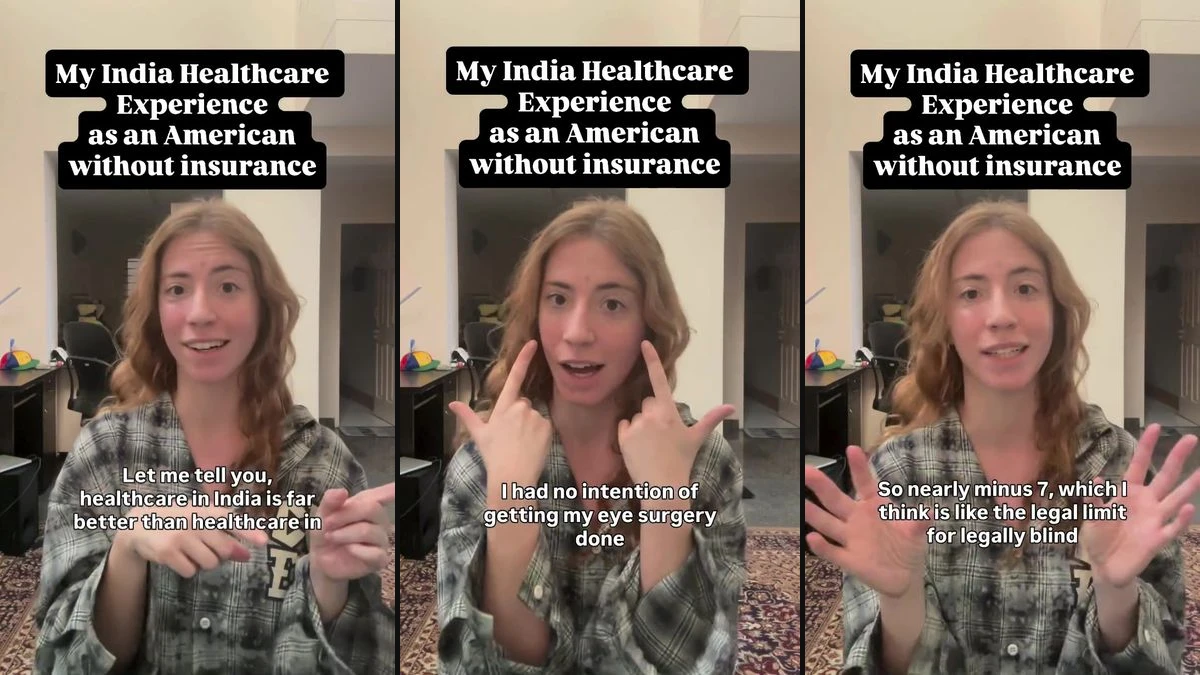
For millions of young Americans, turning 26 brings an abrupt and terrifying rite of passage: aging out of their parents’ health insurance coverage. In a country where an unexpected emergency room visit can trigger a five-figure bill and routine specialist consultations require months of administrative wrangling, living uninsured turns every medical decision into a high-stakes financial gamble.
So when American digital content creator and traveler Stonefish (@ogstonefish) accompanied a friend to an eye clinic in Bengaluru, India, the thought of undergoing surgery herself had never even crossed her mind.
Having lived for years with severe short-sightedness—wearing heavy corrective contact lenses for steep prescriptions of -6.75 in one eye and -6.50 in the other—she had long accepted that corrective eye surgery was financially and medically out of reach in the United States. In America, refractive procedures like LASIK, PRK, or SMILE are routinely classified by private insurers as “elective cosmetic” procedures, carrying out-of-pocket price tags ranging between $4,000 and $6,000 for both eyes.
While sitting in the lobby of Dr. Agarwal’s Eye Hospital in Bengaluru, Stonefish agreed to a routine corneal topography scan out of pure curiosity. What followed over the next seven days permanently altered not just her eyesight, but her entire perspective on modern healthcare.
"Healthcare in India is far better than America. Walked in off the street without insurance, got advanced corneal mapping, booked surgery in seven days, and walked out with 20/20 vision for an all-inclusive price that included a month of follow-up care."
The Seven-Day Sprint: From Severe Myopia to 20/20 Vision
After comprehensive optical scans revealed that her corneal thickness and eye geometry were ideal for refractive correction, the hospital’s senior ophthalmologists mapped out her treatment plan immediately. There were no primary-care provider referrals to request, no multi-week waits for insurance pre-authorizations, and no surprise medical bills lingering in the background.
Within seven days of her walk-in scan, Stonefish was in the surgical suite. The procedure was completed seamlessly, and by her first post-operative checkup the following morning, she was testing at nearly 20/20 visual acuity.
“The doctors have been the absolute best,” Stonefish shared in her viral video detailing her recovery. “Everything was bundled right into the upfront cost. All my eye drops, medications, and a full month of follow-up visits were already covered. In America, you get nickel-and-dimed for every bandage and cotton swab. My experience here blew American healthcare completely out of the water.”
To emphasize the contrast, she recounted the absurd bureaucratic barriers faced by friends back home:
“A friend in the US was recently denied a routine renewal of her contact lens prescription simply because she moved across state lines and her doctor wasn’t licensed in her new state. Meanwhile, I flew halfway across the world, walked into a world-class clinic in Bengaluru with zero insurance, and had my entire vision restored in a week.”
The Math: A 75% Cost Reduction with Zero Gatekeeping
When analyzing the financial benchmarks between the two systems, the disparities illustrate why India has rapidly emerged as a premier global hub for elective and specialized medical care:
- Bilateral Refractive Surgery Costs: In the United States, advanced blade-free femtosecond procedures (such as SMILE or Contoura Vision) typically cost between $2,200 and $3,200 per eye, bringing total bilateral expenses to roughly $4,500 to $6,400. Pre-operative diagnostic scans add another $250 to $400, while prescription steroid and antibiotic drops demand $80 to $150 out-of-pocket.
- The Indian Private Package: At premier Indian eye institutions (including Dr. Agarwal’s, Narayana Nethralaya, and Sankara Nethralaya), the equivalent cutting-edge femtosecond laser procedure ranges from ₹45,000 to ₹1,15,000 total ($540 to $1,380 USD) for both eyes.
- The All-Inclusive Standard: Unlike American medical centers that bill separately for facility fees, surgeon charges, anesthesia, and disposable equipment, Indian private eye hospitals package diagnostics, surgical execution, protective eyewear, and 30 days of post-op consultations into a single transparent quote.
- Wait-Time Discrepancy: In the US or the UK’s National Health Service (NHS), non-emergency specialist ophthalmic appointments often take 8 to 16 weeks to schedule. In India’s urban private hospitals, patients regularly complete initial consultations, comprehensive diagnostic workups, and surgical scheduling within 48 to 72 hours.
The Community Debate: “World-Class Paradise” vs. The Local Divide
When Stonefish’s story was shared on Reddit’s r/indiahealthinsurance, it ignited an intense, multi-perspective debate examining the realities of both nations’ medical landscapes.
Thousands of commenters echoed her astonishment at the speed and human-centered nature of private Indian medicine. Non-Resident Indians (NRIs) and foreign travelers shared parallel experiences:
“I lived in California for eight years and needed three months of back-and-forth phone calls just to get an MRI approved by my insurance company,” commented one software engineer. “When I visited Chennai for Diwali, I walked into a diagnostic center at 9:00 AM without an appointment, paid ₹4,000 ($48), had the scan done by 10:30 AM, and discussed the report with a senior neurologist before lunch.”
However, several community members offered a vital dose of perspective, cautioning against viewing Indian healthcare through rose-tinted glasses:
- The Currency Arbitrage: For an American earning in US dollars or an upper-middle-class Indian with corporate health coverage, spending ₹70,000 out-of-pocket feels trivial. But for an average Indian worker earning ₹25,000 per month, that same procedure represents nearly three months of total pre-tax earnings.
- The Public vs. Private Divide: While India’s private corporate hospitals rival the best facilities in Boston or Zurich, public state-run hospitals frequently grapple with overcrowding, stretched medical staff, and long waiting lines for non-critical procedures.
- Catastrophic Health Risks: Commenters emphasized that while elective day-care procedures (like eye surgery or dental implants) are remarkably cheap in India, major prolonged emergencies (such as cardiac ICU admissions or cancer oncology treatments) can still financially devastate uninsured families who lack structured health policies.
The Industrial Mechanics: Why India’s Eye Care Leads the World
India’s global reputation in ophthalmology is neither an accident nor merely a byproduct of lower labor wages. Medical analysts attribute it to unique industrial factors:
- Unmatched Surgical Volume & Precision: Because India’s private eye chains treat millions of patients annually, an Indian ophthalmic surgeon often completes more cataract and refractive surgeries in a single year than an average Western practitioner performs in an entire career. This immense clinical volume translates directly into surgical mastery, refined instincts, and exceptionally low complication rates.
- Pioneering Surgical Innovations: Institutions like Dr. Agarwal’s are historic pioneers on the world stage. The hospital’s founder and surgeons pioneered groundbreaking techniques including Glued IOL (a sutureless technique for anchoring intraocular lenses) and PDEK (Pre-Descemet’s Endothelial Keratoplasty), which have been adopted by eye surgeons across Europe and North America.
- High Capital Utilization: High-end excimer and femtosecond laser systems (such as the Zeiss VisuMax or Alcon WaveLight) cost upwards of $500,000 to acquire. While a boutique clinic in New York or London might run three or four procedures per week, Indian high-volume centers operate their surgical suites at near-continuous capacity, amortizing expensive capital machinery across thousands of patients and dramatically lowering the per-procedure overhead.
The Broader Human Resonance: Transparent Dignity vs. Administrative Dread
At its core, Stonefish’s viral reflection resonated across borders because it exposed the deep psychological exhaustion created by America’s corporatized healthcare labyrinth.
In the United States, seeking medical treatment has become inseparable from administrative dread: deciphering in-network versus out-of-network providers, wrestling with claims adjusters, and fearing surprise medical bills delivered months after recovery. For millions of young adults navigating the gig economy without employer-backed safety nets, healthcare feels like an adversarial system designed to protect insurer profit margins rather than human well-being.
Stepping into an environment where a patient can consult a world-renowned specialist on a walk-in basis, receive an upfront, unpadded price, and be treated with straightforward professional warmth proved revelatory for Stonefish.
Her spontaneous decision didn’t just give her 20/20 vision—it highlighted a growing global reality where patients are increasingly voting with their feet, proving that when healthcare strips away bureaucratic extortion in favor of clinical excellence and transparent pricing, the results speak for themselves.