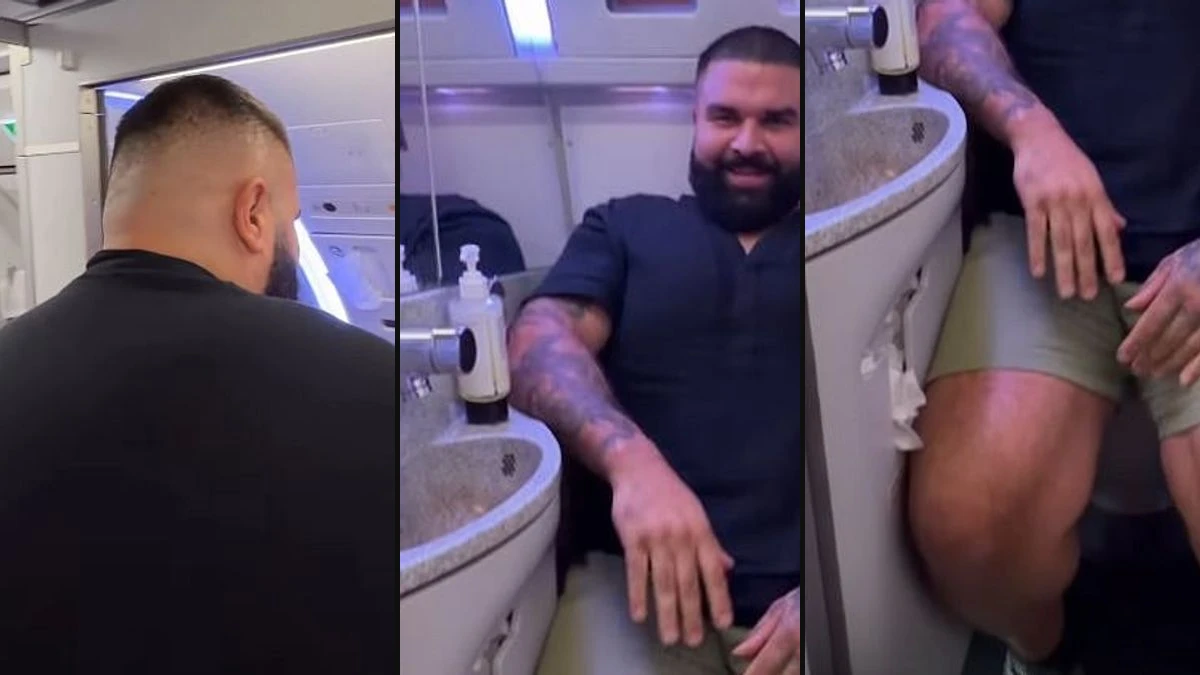
Commercial air travel is rarely celebrated for its abundance of personal space, but for individuals measuring well above the global physical average, stepping onto an airplane often feels less like transit and more like navigating a medieval torture device.
When travel content creators Raymond & Ramisa (@rayandramisa) boarded an Air India commercial flight, Raymond—who stands at an imposing 6 feet 8 inches (203 cm)—decided to pull out his smartphone and record what happens when an athletic, towering human being attempts a routine trip to the onboard restroom.
What followed was a painfully comical sequence: Raymond had to bend his neck at a severe 45-degree angle just to clear the lavatory doorway, contort his broad shoulders sideways to slide into the cubicle, and practically fold himself in half to reach the sink tap without smashing his crown into the curved overhead ceiling panel. The video was shared with exasperation aimed squarely at the carrier: “Trying to fit into an Air India washroom when you’re 6’8”.“
Instead of generating widespread sympathy for the airline, the clip triggered an avalanche of online debate—with thousands of frequent flyers and aviation professionals turning the comments into a live engineering masterclass.
The Aerodynamic Math: 80 Inches vs. a 74-Inch Ceiling
The mathematical conflict inside standard narrow-body and wide-body airliners comes down to human percentile engineering:
- Passenger Physical Stature: Standing at 6 feet 8 inches, Raymond is 80 inches tall. Statistically, this places him above the 99.99th percentile of global male height distributions (where the global average male height is approximately 5 feet 7 inches, or 67 inches).
- FAA & EASA Standard Clearances: Federal Aviation Administration (FAA) and European Union Aviation Safety Agency (EASA) guidelines mandate that commercial lavatory ceiling heights maintain minimum clearances calibrated to the 95th percentile male (roughly 6 feet 2 inches, or 74 inches).
- The Structural Deficit: Raymond faces a physical height deficit of 6 to 8 inches relative to the lavatory’s internal crown. When accounting for the circular curvature of the aircraft fuselage (which sweeps downward aggressively along the outer walls), available vertical standing room narrows to barely 70 inches near the sidewall.
“Air India Doesn’t Manufacture Airplanes”: The Internet Schooling
Aviation buffs, pilots, and aerospace engineers quickly pushed back against the implication that Air India had custom-built an uncomfortably small lavatory out of spite:
“Air India flies Boeing 777s, Boeing 787 Dreamliners, and Airbus A320neos. Air India did not design the fuselage, Boeing and Airbus did. If you board an Emirates 777, an American Airlines 787, or a British Airways A320, the exact same lavatory module built by Safran or Collins Aerospace is waiting for you,” explained an aviation technician in a top-rated comment.
Another commenter tackled the body composition aspect with blunt humor:
“Being 6’8" is one thing, but you also have wide shoulders and a solid gym build. No aircraft lavatory in economy class on planet Earth is built for an NBA power forward!”
Others pointed out the broader consumer realities of modern aviation:
“Bro, regular 5’10" people hit their elbows on the mirror when drying their hands. At 6’8", you need to be booking an exit row or flying business class where the bathrooms have full upright head clearance.”
The Economics of the Shrinking Aircraft Lavatory
Behind passenger discomfort lies one of commercial aviation’s most aggressive cost-cutting design movements: the modular slim-line lavatory.
Over the past decade, aerospace suppliers like Safran Cabin and Collins Aerospace introduced space-saving lavatory modules (such as the Space-Flex on Airbus or Advanced Lavatory on Boeing). By shaving just 4 to 7 inches off the depth of rear lavatories and reconfiguring galley walls, airlines can fit an entire additional row of 6 economy seats into the cabin.
- Revenue Density per Square Foot: In airline network planning, each additional seat row generates an estimated $150,000 to $250,000 in incremental annual ticket revenue over the operational lifetime of a commercial jetliner.
- Weight Savings: Modern composite materials used in slim-line lavatory structures reduce empty airframe weight by dozens of kilograms, yielding compounding jet fuel savings over thousands of flight sectors.
- The Trade-Off: The price of that hyper-optimized efficiency is directly absorbed by passenger comfort. Sink basins are shallow enough that washing hands splashes water onto trousers, and turning around requires a choreography of precision pivots.
For ultra-tall travelers like Raymond, commercial air travel will always remain a battle against physics and financial optimization. But as millions of viewers learned from his viral squeeze, blaming the airline’s tail logo won’t change the cold, calculated blueprints drafted in Toulouse and Seattle.