The “Value Meal” has long been the cornerstone of the fast-food industry, promising customers a small discount in exchange for bundling a main, a side, and a drink. However, a recent viral discovery at a Subway outlet has turned this decades-old marketing logic on its head, leaving the internet questioning the integrity of digital ordering kiosks.
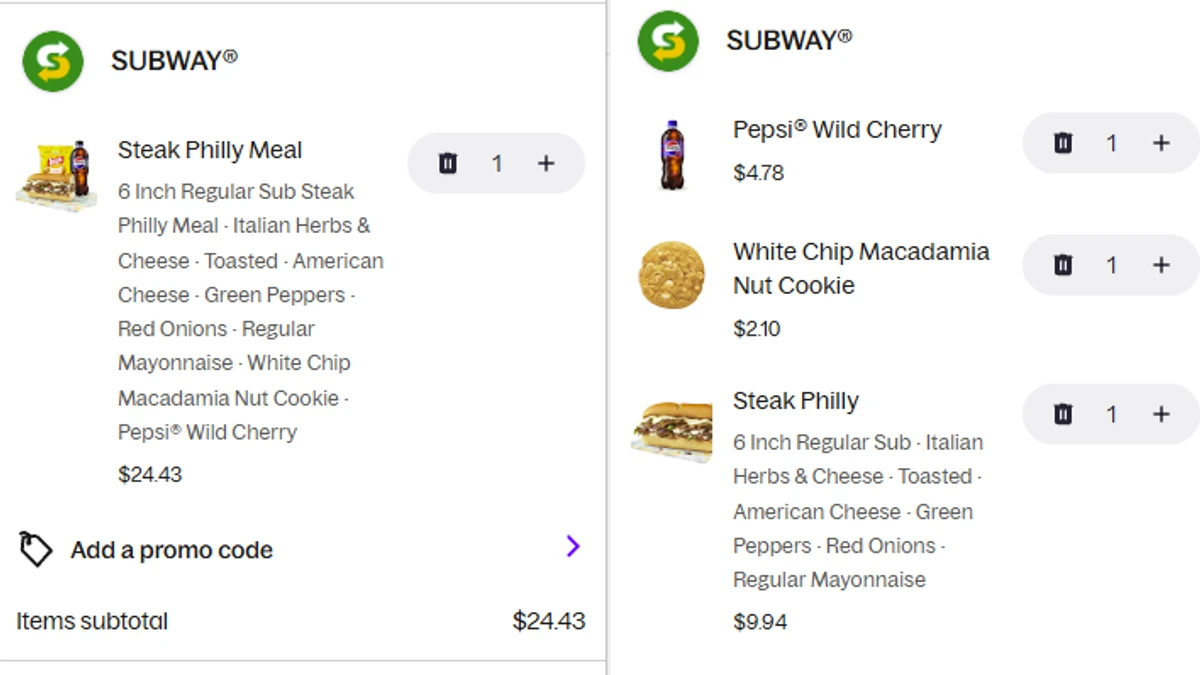
A Reddit user, posting under the handle /u/MapleSurrup, shared a startling realization from a local Subway branch that has since sent shockwaves through the r/mildlyinfuriating community. The user discovered that selecting the “Meal” option on the digital interface added a staggering $7.20 to the total—far exceeding the combined cost of the individual chips and drink.
Original Post via Reddit (r/mildlyinfuriating): “Subway charging over $7 more for a ‘meal’ instead of individual items.”
Breaking Down the “Math That Isn’t Mathing”
The viral image shared by /u/MapleSurrup provides a clear, albeit confusing, look at the digital checkout screen. In the world of fast-food economics, a meal deal typically shaves off 50 cents to a dollar from the total. In this instance, the “convenience” of the meal button came with a premium that many are calling a “lazy tax” or a massive technical glitch.
- The Footlong Sub: The base price for the sandwich shown was approximately $10.49.
- The Individual Add-ons: A standard bag of chips at this location retails for roughly $1.59, while a medium fountain drink sits at $2.29.
- The Individual Total: If a customer manually added these three items to their basket, the total would come to $14.37 (plus tax).
- The “Meal” Price: The kiosk displayed a total of $21.57 for the “Meal” bundle, representing a markup of $7.20 for the exact same items.
This discrepancy suggests that the “Meal” button was programmed to add a flat fee that was never reconciled with the actual prices of the side items. For customers moving quickly through a digital interface, this $7 error could easily go unnoticed until the credit card is already tapped.
The Mechanics of the Digital Menu Glitch
To understand how a global giant like Subway ends up with a $7 pricing error, one must look at the franchise-heavy nature of the business. Unlike corporately owned chains, Subway operates almost entirely through independent franchisees. These owners often have the autonomy to set their own prices within their Point of Sale (POS) systems, but this freedom can lead to catastrophic errors when digital menus are updated.
Software updates for ordering kiosks often come from a central corporate server, but the specific pricing “layers” are populated by local store data. If a franchisee incorrectly enters a “Meal Upcharge” value—perhaps intending to set it at $3.50 but accidentally doubling it or failing to account for a change in base sandwich prices—the kiosk will faithfully execute the bad math.
Furthermore, the rise of third-party delivery integration has complicated these systems. Many POS platforms now sync prices across UberEats, DoorDash, and in-store kiosks. If a store applies a “delivery markup” to a bundle but forgets to toggle it off for in-store customers, the result is the inflated price seen in the viral post. This creates a trap for the unwary diner who assumes the “Bundle” button is always the most economical choice.
The Internet Reacts: “The Death of the Value Menu”
The Reddit thread quickly became a hub for frustrated fast-food fans who have noticed a trend of “deceptive” pricing across various chains. The consensus among netizens is that the era of the transparent, affordable “Value Meal” is rapidly being replaced by complex digital pricing structures that require a calculator to navigate.
- “It’s a lazy tax,” commented one user. “They know most people just click ‘Make it a Meal’ without looking at the subtotal. If they catch 10% of people with this, it’s pure profit.”
- “I had this happen at a different chain,” another Redditor shared. “The ‘2 for $6’ deal actually cost more than buying two individual items because the individual items were on a separate local sale. The system doesn’t check for the best price; it just does what you tell it.”
- “This is why I always check the itemized list,” a third commenter noted. “Digital kiosks are designed to rush you. They use bright colors and big buttons to guide you toward the highest-margin options.”
- “Subway’s pricing has become wild,” added another. “Between the ‘Subway Series’ menu and the app glitches, you can pay $12 or $22 for the same sandwich depending on how you click.”
Community Verification and Similar Experiences
The skepticism often found on Reddit was quickly replaced by a wave of verification. Other users began sharing screenshots of their own local Subway apps showing similar, though perhaps less extreme, discrepancies. In many cases, the “Meal” upgrade was found to be exactly equal to the cost of the drink and chips, offering zero savings—a far cry from the original intent of a “deal.”
This phenomenon isn’t limited to Subway. Industry analysts have noted that as fast-food prices have climbed—some rising by over 40% since 2019—the logic behind bundling has shifted. Chains are increasingly using “dynamic pricing” models similar to airlines, where prices can fluctuate based on time of day, location, or the platform used for ordering.
Broader Resonance: Why This Matters to Consumers
This viral moment connects with a broader cultural anxiety regarding “Greedflation” and the erosion of consumer trust. For decades, the “Combo” or “Meal Deal” was a reliable social contract: the customer buys more items, and the business provides a small discount. When that contract is broken—especially by a margin as wide as $7—it feels less like a mistake and more like a predatory tactic.
As digital kiosks replace human cashiers, the “human check” in the transaction disappears. A cashier might notice that a total seems unusually high for a single meal, but a kiosk will simply wait for a credit card. This puts the entire burden of price verification on the consumer, who is often distracted or in a hurry.
The Subway incident serves as a high-profile case study in the importance of digital literacy in the modern food landscape. It highlights a growing need for “price transparency” in app design, where systems should ideally alert a customer if they are choosing a more expensive way to order the same items. Until then, as /u/MapleSurrup’s post suggests, the best tool a diner has is a quick bit of mental math before hitting “Confirm Order.”
Subway has not issued an official statement regarding this specific kiosk’s pricing, but the post remains a top trending topic in consumer advocacy circles, reminding everyone that in the age of the algorithm, the “deal” isn’t always what it seems.