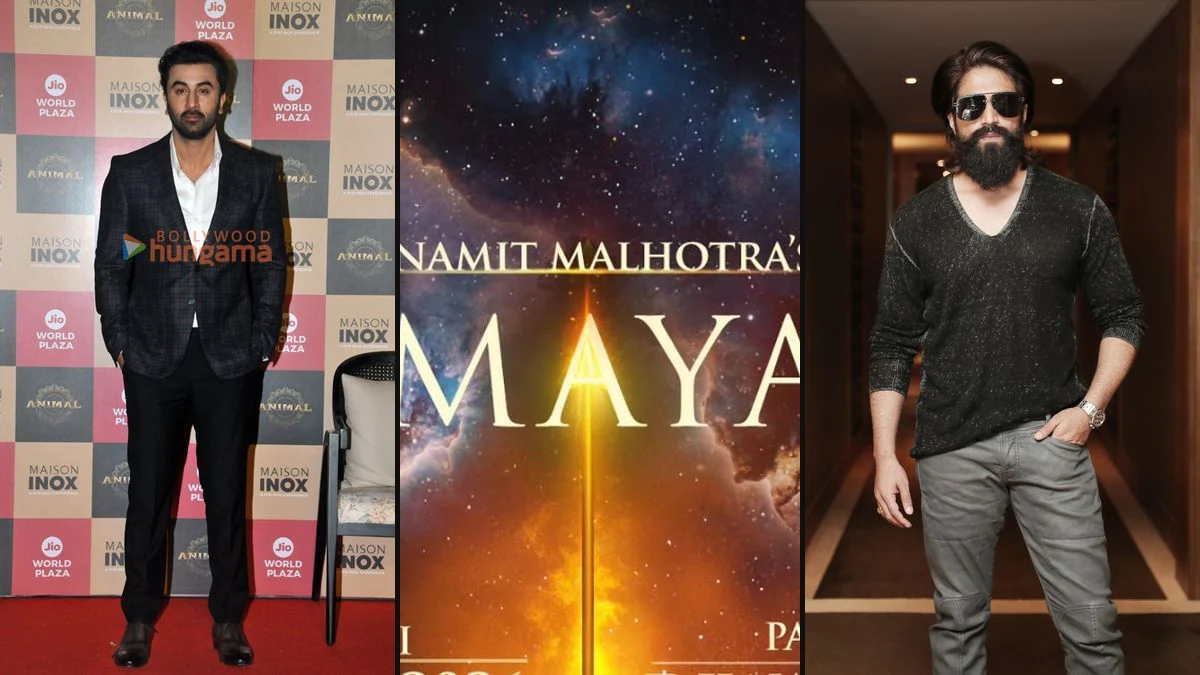
After years of clandestine script sessions, leaked set photographs, and breathless trade rumors, Hollywood visual effects powerhouse Prime Focus and DNEG officially pulled back the curtain on the single most anticipated cinematic venture in Indian film history. Taking directly to Instagram, producer and global CEO Namit Malhotra formally unveiled the title artwork and global theatrical timeline for director Nitesh Tiwari’s two-part magnum opus, Ramayana.
The announcement did far more than confirm long-whispered industry chatter; it locked in a massive two-part theatrical calendar slated for Diwali 2026 and Diwali 2027. Anchored by Bollywood superstar Ranbir Kapoor stepping into the sacred mantle of Lord Rama and Kannada cinema titan Yash taking on the complex antagonist Ravana while simultaneously joining as co-producer via Monster Mind Creations, the project represents an unprecedented convergence of global Hollywood infrastructure and sacred Eastern storytelling.
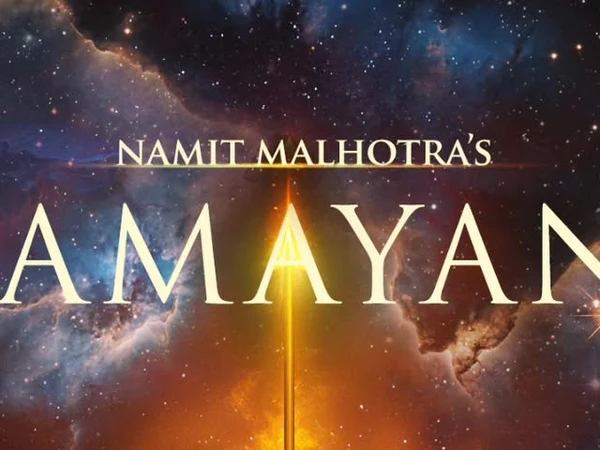
“More than a decade ago, I embarked on a noble quest to bring this epic that has ruled billions of hearts for over 5000 years to the big screen,” Malhotra shared in his emotional manifesto. “And today, I am thrilled to see it taking shape beautifully as our teams work tirelessly with only one purpose: to present the most authentic, sacred, and visually stunning adaptation of our history, our truth, and our culture – our ‘RAMAYANA’ – for people across the world. Join us as we fulfill our dream of bringing our greatest epic to life with utmost pride and reverence… Part 1 in Diwali 2026 and Part 2 in Diwali 2027.”
Within minutes, the announcement sparked an avalanche across Reddit, X, and Instagram, racking up hundreds of thousands of shares and establishing itself as the paramount talking point across global entertainment communities.
The Math & The $100M+ Financial Benchmark
To appreciate the sheer velocity of this viral revelation, one must examine the staggering financial architecture underpinning the production. With an estimated combined budget exceeding $100 million (approximately ₹835 to ₹850 Crore), Ramayana is officially the most expensive cinematic endeavor ever financed in the history of Indian motion pictures.
Unlike conventional Indian multi-starrer productions where upwards of 60% of the financial capital is consumed by above-the-line talent remuneration, Malhotra and his financial partners have strategically inverted the resource allocation model. Industry insiders reveal that over 65% of the total capital expenditure has been directly ring-fenced for practical physical sets, historical textiles, and groundbreaking visual visual effects pipeline integration.
Shooting Part 1 and Part 2 in continuous succession across extensive closed soundstages in Mumbai’s Film City and on-location practical environments has allowed the production to achieve significant production efficiencies. Rather than releasing individual chapters years apart, locking in back-to-back Diwali dates (Diwali 2026 and Diwali 2027) establishes an unprecedented two-year holiday event strategy engineered for global IMAX and premium large format (PLF) exhibition across more than 50 international territories.
The Community Skepticism & Post-Adipurush Trauma
While excitement across social channels erupted instantaneously, the digital reaction was simultaneously tempered by profound vigilance. Following the disastrous critical and cultural fallout of the 2023 big-budget adaptation Adipurush—which faced intense public backlash for cartoonish visual effects, distorted character aesthetics, and colloquialized dialogue—Indian audiences have developed an acute sensitivity toward sacred mythological interpretations.
Online movie communities on Reddit’s r/bollywood and r/tollywood immediately parsed the announcement through a lens of rigorous scrutiny:
- Netizens passionately demanded a complete rejection of tacky green-screen digital doubles, urging the makers to prioritize physical architectural sets and authentic period costuming.
- Discussion threads highlighted the physical transformation of Ranbir Kapoor, who stepped away from all public brand endorsements and underwent grueling daily bodyweight conditioning, voice modulation coaching, and dietary abstinence to embody the grace and ascetic discipline demanded of Lord Rama.
- Audiences celebrated the casting of Sai Pallavi as Mata Sita, highlighting her natural screen presence, cultural dignity, and authentic emotional depth as a vital antidote to glossy modern Bollywood conventions.
- Fans praised the strategic decision by K.G.F. sensation Yash to not only portray Ravana with raw, operatic grandeur but also step in as co-producer, ensuring that the visual gravitas and narrative integrity of the antagonist match the epic’s legendary scale.
The Technical & Industrial Mechanics: 7 Academy Awards Meets Ancient Lore
What fundamentally sets this adaptation apart from any previous Indian mythological film is its unprecedented technical backbone. Namit Malhotra’s visual effects company, DNEG, is an undisputed global titan, having garnered seven Academy Awards for Best Visual Effects on cinema benchmarks including Christopher Nolan’s Interstellar and Tenet, Denis Villeneuve’s Dune: Part One and Dune: Part Two, and Blade Runner 2049.
Rather than outsourcing digital sequences across fragmented external vendors, Ramayana is being developed entirely within DNEG’s proprietary photorealistic pipeline. This guarantees world-class volumetric lighting, realistic creature dynamics for the Vanara army, and hyper-detailed digital landscape reconstruction for ancient Ayodhya, Kishkindha, and Lanka.
Equally historic is the musical collaboration backing the visuals. For the first time in cinematic history, two-time Academy Award-winning maestro Hans Zimmer (The Lion King, Gladiator, Dune) is joining forces with India’s own two-time Academy Award winner A.R. Rahman (Slumdog Millionaire, Roja, Lagaan). The pairing represents a monumental cross-cultural synthesis, blending traditional Indian classical ragas and ancient devotional chants with thunderous Hollywood orchestral brass and percussive scoring.
Guiding the ship at the directorial helm is Nitesh Tiwari, whose 2016 biographical drama Dangal remains the highest-grossing Indian film of all time globally ($240+ million). Tiwari’s proven genius for emotional restraint, organic character arcs, and human groundedness serves as the essential creative anchor preventing the $100 million spectacle from devolving into empty visual bombast.
The Broader Cultural & Global Resonance
Beyond the box-office economics and cinematic technicalities, the unveiling of Ramayana carries immense civilizational resonance. For generations, the epic journey of the Ramayana has served as the ethical, spiritual, and moral bedrock for over a billion people across the Indian subcontinent and Southeast Asia.
In past decades, Western cinema successfully translated its own epic traditions—from J.R.R. Tolkien’s The Lord of the Rings to Frank Herbert’s Dune—into universally acclaimed global box office triumphs. With Namit Malhotra, Yash, and Nitesh Tiwari marshaling world-class talent, state-of-the-art visual mastery, and deep reverence, Indian cinema is taking its most definitive step toward establishing its timeless historical lore on the world stage.
As Diwali 2026 draws closer, the internet’s eyes remain locked on every move from the production floor. If this initial visual reveal is any indication, audiences around the globe are about to witness an epic cinematic odyssey that bridges millennia of sacred storytelling with the pinnacle of 21st-century filmmaking craft.