In the densely populated high-rise sectors of Noida, few announcements spark more immediate terror than reports of a residential tower fire. With tens of thousands of families living on floors situated hundreds of feet above ground level, the memory of real-world electrical short circuits and split air-conditioner compressor explosions across the National Capital Region remains a persistent collective anxiety.
On Monday evening, November 9, 2026, that latent dread was weaponized when a hyper-realistic video began circulating furiously across local WhatsApp society networks, X (formerly Twitter), and community Telegram channels.
The terrifying clip depicted an inferno raging on the 21st floor of Unnati The Aranya Society, a prominent multi-tower residential complex in Noida’s Sector 119. Accompanied by frantic captions claiming a massive “AC blast” had trapped residents inside their homes, the footage showed violent orange flames licking balcony railings and thick columns of dark smoke billowing into the evening sky.
Within minutes, the viral panic spilled into the emergency dispatch rooms of the Uttar Pradesh Fire Service and the Noida Police Commissionerate.
The Emergency Scramble: Sirens Across Noida
Confronted with visual evidence that appeared catastrophically genuine, emergency officials treated the viral footage as a Tier-1 life-safety crisis:
- Four Fire Engines Dispatched: The Gautam Buddha Nagar Fire Department immediately sounded the alarm, dispatching four heavy water tenders and hydraulic platforms from Sector 58 and Phase-3 fire stations with emergency sirens blaring through peak-hour traffic.
- Regional Mutual-Aid Alerts: Given the claimed altitude of the fire—on the 21st floor, where high-pressure aerial snorkel ladders are mandatory—fire control coordinators placed backup units across four neighboring sub-districts on standby.
- Police Interceptor Mobilization: Local police patrol vans (PRVs) and senior station officers from the Sector 113 police jurisdiction raced to cordoned off the perimeter around Sector 119.
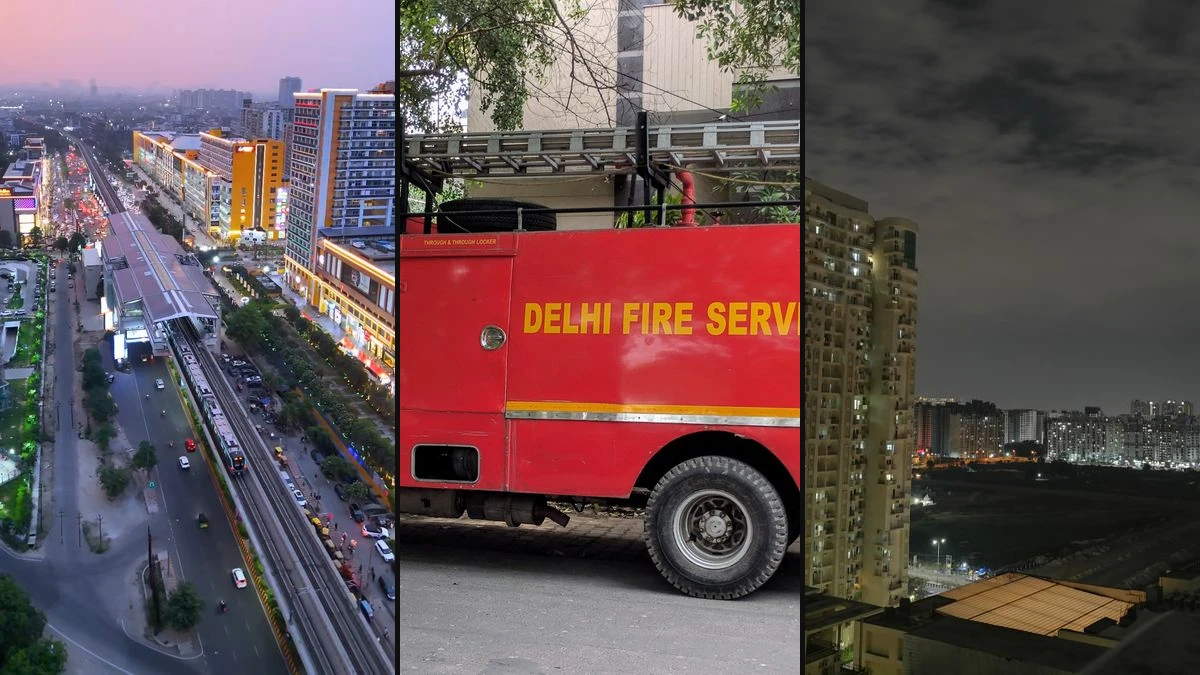
Yet, when the first convoy of emergency vehicles screeched to a halt outside the main security gates of Aranya Society, the scene that greeted firefighters was utterly surreal.
There were no screaming residents. There was no falling debris. There was no smell of charred insulation or burning drywall. Above all, there was neither a wisp of smoke nor a single flicker of flame across any of the complex’s towering residential facades.
Instead, evening walkers were strolling quietly along the landscaped podium, children were playing in the central park, and security guards stood puzzled at the sudden arrival of four massive red fire engines.
“No Fire, No Blast”: The Digital Forensic Reality
Firefighters and police teams immediately entered the tower and conducted a floor-by-floor inspection, ascending all the way to the 21st and 22nd floors. Every single apartment, balcony, and utility shaft was found completely intact, secure, and undisturbed.
Speaking on the bizarre turn of events, officials from the Noida Fire Service and the Chief Fire Officer (CFO) confirmed that the viral video was a complete fabrication generated using advanced Artificial Intelligence (AI) synthesis tools.
“Our teams received multiple frantic calls citing a video circulating on social media of a major fire caused by an AC blast on the upper floors of Aranya Society in Sector 119,” fire officials stated. “We deployed four vehicles and mobilized emergency teams immediately. Upon arrival and physical inspection of the building, we found that the video was completely fake and created using AI. There was no fire, no smoke, and no emergency whatsoever.”
Subsequent digital analysis of the viral video revealed unmistakable signatures of synthetic media generation:
- Unnatural Flame Fluid Dynamics: While the fire appeared convincing on small mobile phone screens, frame-by-frame inspection showed identical flame flicker loops repeating every 1.8 seconds.
- Missing Volumetric Lighting & Reflections: In authentic high-rise night fires, raging flames cast dynamic specular reflections across adjacent glass windows and concrete facade panels. In the AI clip, the surrounding walls remained uniformly lit by ambient evening light without corresponding heat glow.
- Synthetic Smoke Textures: The billowing black smoke lacked authentic turbulence physics, clipping unnaturally through balcony railings rather than wrapping around structural pillars.
The Real-World Danger of Digital Hoaxes
While no physical damage was sustained at Sector 119, civic authorities pointed out that the creation and dissemination of synthetic crisis media represents a severe threat to public safety.
In a rapidly expanding metropolis like Noida, municipal fire services operate under demanding resource allocations. By mobilizing four fire engines and placing regional teams on high alert, the hoax diverted critical emergency machinery away from legitimate distress calls across the industrial and commercial sectors.
Furthermore, the psychological toll on high-rise communities is profound. In modern condominium societies housing 1,500 to 3,000 apartments, false fire alarms frequently trigger stampede-like evacuations down narrow fire stairwells, where elderly residents and young children risk traumatic crush injuries in the panic.
“People post these fabricated clips for online views, sensationalism, or cheap digital engagement without realizing the catastrophic consequences,” commented a senior Noida Police officer. “Diverting emergency vehicles through congested city traffic endangers lives on the road and leaves actual victims elsewhere unprotected.”
Police Crackdown & Cyber Crime Cell Registration
The Noida Police Commissionerate has taken strict cognizance of the malicious hoax. Local police stations, in coordination with the Gautam Buddha Nagar Cyber Crime Cell, have officially registered a case and initiated an aggressive digital trace to identify the IP addresses, handles, and accounts responsible for synthesizing and initially uploading the deepfake footage.
Legal authorities confirmed that the creator and primary disseminators face serious criminal charges under the Bharatiya Nyaya Sanhita (BNS) and the Information Technology Act:
- Section 353 of the BNS (Circulating False Information / Public Mischief): Applicable to individuals who create or circulate statements, rumors, or reports with intent to cause fear or alarm to the public, carrying sentences of imprisonment.
- Section 66D of the IT Act (Cheating by Personation Using Computer Resource): Penalizing the intentional manipulation and digital synthesis of false representations.
- Section 54 of the Disaster Management Act: Mandating up to one year of imprisonment for false alarms or warnings regarding impending disasters or emergency hazards.
Police officials cautioned netizens that sharing unverified sensationalist videos without source validation can also incur secondary legal liability.
High-Rise Living in the Age of Generative AI
The Sector 119 hoax marks a troubling milestone in the evolution of generative artificial intelligence in India. What was once confined to amusing digital face-swaps and synthetic celebrity voices has now crossed into municipal infrastructure disruption and panic-mongering.
For residents of Noida’s high-rise corridors—stretching from Sector 74 to the expressway hubs of Sector 137 and Sector 150—the incident serves as a stark wake-up call. Apartment Owners Associations (AOAs) and Resident Welfare Associations (RWAs) across the city have begun issuing advisories urging residents never to broadcast unverified emergency clips on society broadcast lists before confirming with local security desks or official fire control rooms.
As Noida Police tighten their net around the digital hoaxer, the empty fire ladders outside Aranya Society stand as an eerie reminder of modern urban reality: in an era of hyper-realistic generative video, the most dangerous fire in the city can be ignited by a single prompt.