For Italian culinary purists, the debate over putting pineapple on pizza is not a whimsical meme or a casual gastronomic preference—it is a sacred line in the flour that must never be crossed. But for one Italian head chef in Australia, defending that ancient culinary dogma against paying customers proved to carry catastrophic real-world consequences.
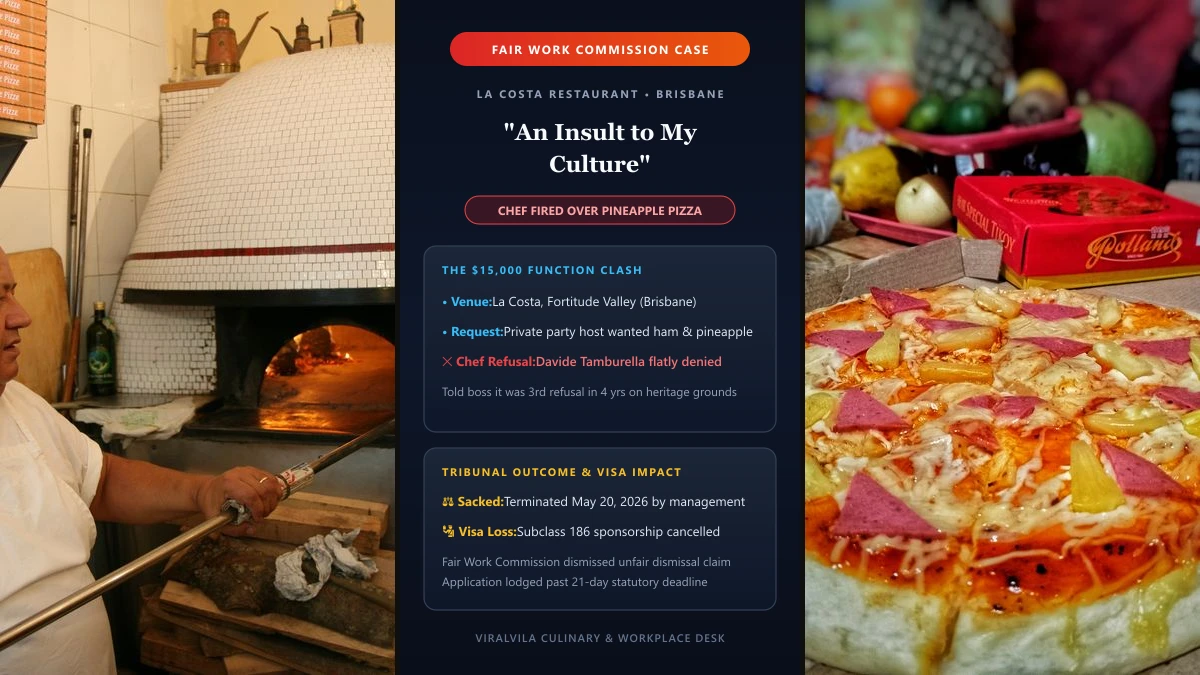
Davide Tamburella, an Italian-born chef who spent over three years leading the kitchen at La Costa Restaurant and Bar in the bustling Fortitude Valley district of Brisbane, found himself locked in an irreconcilable showdown with management during a high-stakes corporate event. When a client hosting a private function spending in excess of $15,000 AUD requested a simple round of ham-and-pineapple pizzas, Tamburella flatly refused to fire up the dough, declaring the order “an insult to my culture.”
"We had a large function come in spending in excess of $15,000, and the guy paying for the whole thing says: 'Look, I need to get some ham and pineapple pizza.' The chef refused, saying it was an insult to his culture... but at the end of the day, we are in Australia, not Italy."
The showdown triggered a formal disciplinary process, leading to Tamburella’s dismissal on May 20, 2026. The firing sent shockwaves through Australia’s hospitality sector and quickly went viral across Reddit’s r/nottheonion and r/australia, pitting traditional kitchen autonomy against the foundational commercial reality of modern dining.
The $15,000 Showdown on Brunswick Street
Nestled along Brunswick Street in Brisbane’s entertainment heartland of Fortitude Valley, La Costa was marketed as an authentic coastal escape. Complete with seafoam-green decor, exposed brick columns, European oak tables, and Neapolitan wood-fired recipes, the restaurant promised diners: “It’ll only take a moment to realize you’re not in Brisbane anymore, you’ve made it to the Italian Riviera.”
For chef Tamburella, that promise was literal. Having honed his craft in Italy, he viewed authentic culinary standards as non-negotiable.
The breaking point arrived when a corporate party reserved the venue for a lavish private function. With the host dropping over $15,000 AUD on food and beverages, the client requested a spread of pizzas that included traditional Hawaiian toppings—cured ham paired with sweet pineapple chunks.
When restaurant owner Elliot Ingram conveyed the customer’s request to the kitchen, Tamburella refused to comply. He told management that putting tropical fruit onto pizza violated his professional integrity and insulted Italian food heritage. He even advised Ingram to “check how important it is for Italians not to put pineapple on a pizza.”
During subsequent tribunal hearings, evidence revealed that this was not a spontaneous disagreement. It was the third time over a four-year period that Tamburella had outright refused management’s direct instruction to prepare pineapple pizza for customers.
The True Cost: A Canceled Permanent Residency Visa
While internet commenters treated the saga as the ultimate embodiment of Italian culinary passion, the real-world fallout was severe.
Tamburella was more than three years into an employer-sponsored Subclass 186 Employer Nomination Scheme visa—a vital immigration pathway providing skilled foreign workers with permanent residency in Australia.
When Ingram dismissed Tamburella following the function incident, the legal mechanism of Australian immigration law kicked in. Although Ingram delayed notifying immigration authorities as long as statutory guidelines permitted in the hope that Tamburella’s visa might finalize, the termination eventually required the restaurant to formally withdraw its sponsorship.
As a consequence of refusing to slice pineapples for a paying guest, the chef lost his permanent residency pathway, forcing him to restart the lengthy, expensive visa process from scratch with a new sponsor.
The Fair Work Commission Ruling: Why the Appeal Failed
Tamburella subsequently filed an unfair dismissal and general protections claim against La Costa with Australia’s Fair Work Commission (FWC). In his submission, the chef alleged that the dismissal breached the Fair Work Act 2009, asserting that management’s decision was also prejudiced by a workplace injury he sustained when he struck a metal handrail and fractured two bones in his right hand.
However, the legal dispute hit an insurmountable procedural barrier. Fair Work Commissioner Jennifer Hunt dismissed Tamburella’s application because it had been filed outside the mandatory 21-day statutory limitation period set under Section 366 of the Fair Work Act.
Commissioner Hunt ruled that Tamburella failed to establish the “exceptional circumstances” required by law to grant an extension of time. While the commissioner did not make a formal ruling on whether refusing to cook pineapple pizza constitutes valid grounds for termination, her written assessment offered a sobering perspective on workplace realities:
“The lawful reasons provided for the decision to dismiss Mr Tamburella appear to me to be strong. Mr Tamburella’s frustration within the workplace and the way that he behaved on numerous occasions would lead me to conclude that his prospects of success are not great.”
Tribunal documents highlighted that management’s formal termination notice cited a broader record of friction, including inappropriate workplace language, verbal escalation during high-pressure dinner services, and insubordination in refusing direct management directives.
The Science and Culture: Why Pineapple on Pizza Infuriates Italy
The fierce resistance that cost Tamburella his job is rooted in deep historical and gastronomic tradition.
Contrary to its tropical name, Hawaiian pizza was not invented in Honolulu or Maui. It was created in 1962 in Chatham, Ontario, Canada, by Greek-Canadian restaurateur Sam Panopoulos at the Satellite Restaurant. Inspired by the sweet-and-sour flavor profiles of North American Chinese cuisine, Panopoulos decided to experiment by tossing canned pineapple slices onto a cheese and ham pizza.
To traditional Italian pizzaiolos, however, the combination is considered an assault on flavor chemistry:
- Moisture Content and Crust Integrity: Fresh and canned pineapples contain approximately 86% water. When subjected to the blistering 450°C to 500°C temperatures of a traditional Neapolitan wood-fired oven, the fruit releases excessive moisture, turning the crisp, leopard-spotted cornicione (crust) into a soggy paste.
- Enzymatic Breakdown: Pineapple contains bromelain, a potent proteolytic enzyme that breaks down proteins. When placed on dairy, bromelain starts degrading the structure of fior di latte or mozzarella, causing the melted cheese to curdle and turn runny.
- Acid-Sugar Conflict: Authentic Italian pizza celebrates balance—the natural acidity of San Marzano plum tomatoes counterbalanced by the rich fats of buffalo mozzarella and pecorino, fragrant basil, and grassy extra virgin olive oil. The sharp sweetness of caramelized fructose in pineapple overwhelms the delicate balance of authentic Italian ingredients.
- Legal Heritage Protection: In Italy, pizza is not viewed as a blank canvas for arbitrary toppings. The Associazione Verace Pizza Napoletana (AVPN) enforces strict regulations on dough hydration, fermentation, and permitted toppings, while UNESCO inscribed the traditional art of the Neapolitan Pizzaiuolo onto its Representative List of the Intangible Cultural Heritage of Humanity in 2017.
Customer Sovereignty vs. Culinary Integrity
For restaurant owner Elliot Ingram, managing a commercial kitchen required balancing cultural respect with economic survival. With 17 years in the hospitality industry, Ingram noted that while ham and pineapple was not his personal preference, hospitality ultimately demands delivering what customers pay for:
“Do I go and buy a ham and pineapple pizza? It’s probably not my absolute favourite. But I’m not going to turn my nose up at it, that’s for sure. We’ve had ham and pineapple pizza on the kids’ menu previously. At the end of the day, we’re not in Italy. We’re in Australia, and we have to go with what the customers’ reasonable requests are.”
The dilemma touches on a fundamental conflict across modern restaurants: Should an authentic ethnic eatery strictly preserve ancestral traditions, or should it adapt flexibly to local palates?
While high-end culinary artists often retain absolute menu veto power, casual and mid-tier establishments operating under slim margins depend heavily on accommodating paying private functions.
The Aftermath: New Kitchen, Zero Pineapples
The saga concluded with mixed fortunes for everyone involved:
- La Costa’s Fate: The restaurant permanently ceased operations in July 2026 following the expiration of its commercial lease. Ingram cited soaring commercial rents and the rising cost of doing business in Fortitude Valley.
- Tamburella’s Path: The Italian chef successfully secured a head chef role at another traditional Italian establishment in Brisbane. True to his principles, his new restaurant’s menu strictly forbids tropical fruit, ensuring he will never again be ordered to slice a pineapple.
- The Internet’s Verdict: On social media, Tamburella was celebrated as a folk hero by Italian expatriates and pizza purists worldwide, with one viral commenter quipping: “He lost his visa, but he saved his soul.”
While his unwavering defiance cost him a multi-year residency pathway and his employment, Davide Tamburella proved one indisputable fact to the culinary world: for an authentic Italian pizzaiolo, pride will always be more valuable than pineapple.