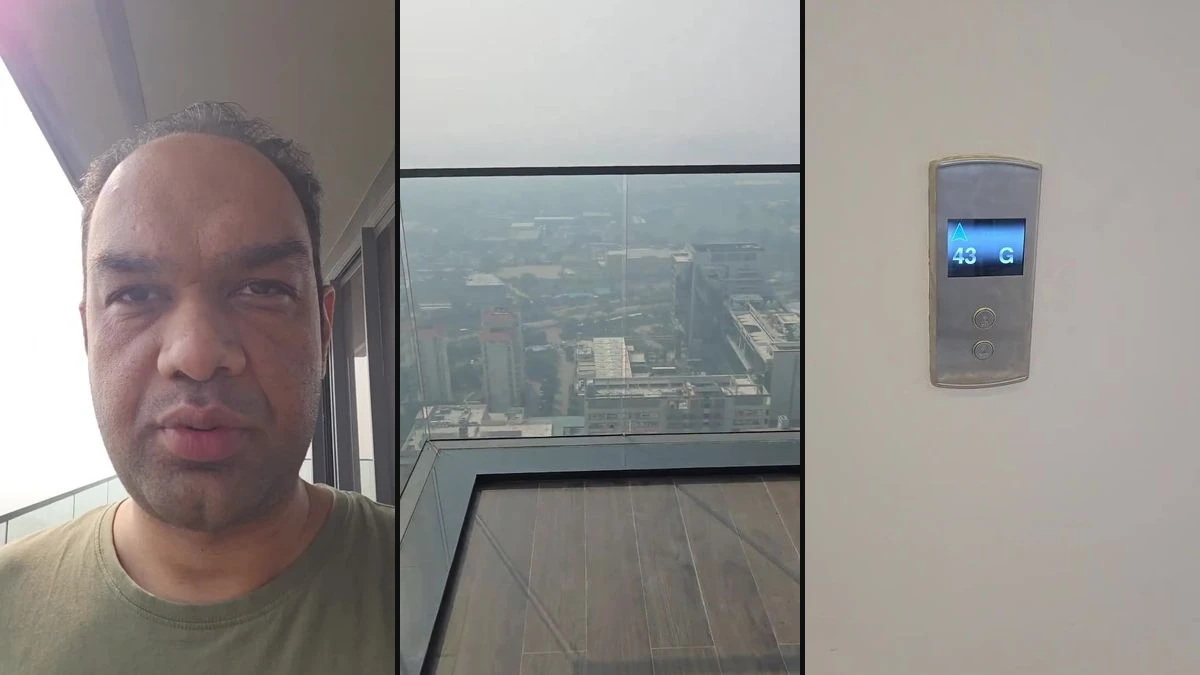
In India’s luxury real estate circles, a signature address on Golf Course Extension Road is marketed as the pinnacle of elite urban living. Yet, for one Gurugram homeowner who poured nearly ₹7 crore into an ultra-luxury high-rise, moving into his dream penthouse felt less like stepping into five-star hospitality and more like being held in high-altitude confinement.
The ordeal erupted into national headlines after Varun Suhag, founder of an aviation consulting firm and owner of Apartment 36C in Tower C of Trump Towers Delhi NCR, shared video evidence on X (formerly Twitter) showing that the elevator call button on his 36th-floor landing had been physically disabled by facility management. The viral footage, which initially exploded on X before spreading across Reddit’s r/GatedCommunitiesIndia and r/gurgaon communities, sparked disbelief over how a multi-million-dollar homeowner could be effectively stranded 100 meters in the air.
I the owner of Apartment number 36C, Trump Towers Delhi NCR, Sector 65, Gurugram have been put under house arrest by the builder M3M and management, Mr. Pankaj Bansal.
— varun suhag (@varunsuhag) November 1, 2026
"I the owner of Apartment number 36C, Trump Towers Delhi NCR, Sector 65, Gurugram have been put under house arrest by the builder M3M and management..."
Key Highlights of the Luxury Standoff
- The Multi-Crore Investment: Varun Suhag purchased Flat 36C in 2018 for ₹6.68 crore; the property’s current secondary market valuation stands between ₹10 crore and ₹12 crore.
- The Disabled Panel: Upon moving in on October 26, 2026, the homeowner discovered the 36th-floor Lift Operating Panel (LOP) had been powered down and locked, requiring on-duty security guards to operate elevators with physical master keys.
- Vulnerable Family Stranded: The household includes Suhag’s elderly mother—who suffers from a chronic cardiac ailment—and his one-year-old infant, both left stranded during routine emergencies.
- Extended Delays for Deliveries: Basic groceries, drinking water jars, and domestic staff were regularly held at security gates or delayed by 30 to 45 minutes while waiting for manned elevator assistance.
- The Developer’s Protocol: Project developer M3M India maintained that restrictions were implemented solely for site safety, citing over 200 active interior fit-out workers operating in neighboring unfinished units.
The 36th-Floor Reality: Waiting 40 Minutes for an Elevator
Varun Suhag originally booked the apartment in 2018 while based in Dubai, envisioning a peaceful return to the National Capital Region. However, after an 18-month construction delay that had previously reached the Haryana Real Estate Regulatory Authority (HRERA), he finally received official handover on August 27, 2026.
After spending nearly ₹10 lakh out of his own pocket to complete pending electrical fittings, false ceilings, and interior touch-ups that the developer had allegedly left unfinished, Suhag, his wife, his mother, and their infant daughter vacated their rented flat in DLF Phase 3 and officially moved into Flat 36C on October 26.
Instead of luxury living, Suhag was greeted by locked controls. When pressing the elevator call button on the 36th-floor lobby, nothing responded. The developer’s facilities team had disabled the floor’s button interface, preventing the lift from stopping on level 36 unless manually overridden by security personnel using specialized keycards from the ground level.
“Every single time my family needed to step out or receive a delivery, we had to call the society helpdesk and wait 30 to 40 minutes for a guard to physically key in our floor from the basement,” Suhag explained in his video dispatch. “My mother has severe heart disease. If an ambulance is needed, how can we wait three-quarters of an hour just to reach the ground floor?”
The logistical bottlenecks quickly turned absurd. Courier executives carrying baby formula, water delivery personnel, and housekeeping staff were repeatedly denied entry at the boom barrier or turned away when guards claimed the upper floors were not cleared for normal transit.
The Builder’s Defense: Safety During Fit-Out Phases
As Suhag’s posts racked up more than 1.9 million impressions on X, the developer, M3M India—which constructs and markets the Trump Towers complex under license—issued a formal clarification rejecting the characterization of “house arrest.”
According to the developer’s facility management arm, restricting automated elevator stops on specific upper levels is standard operating procedure during ongoing handover phases. The developer highlighted that more than 200 contract laborers, carpenters, and interior vendors enter Tower C daily to carry out fit-out works on behalf of other unit buyers.
Management argued that allowing unrestricted elevator operation across floors with vacant, open construction shells posed severe safety, theft, and unauthorized access hazards. Furthermore, the company asserted that fire stairwells remained completely open at all times and that service lifts with dedicated operators were continuously stationed on-site to assist moving families.
M3M also stated that Suhag had been informed in early October that automated floor calls would be activated once formal occupancy documentation and building fit-out clearances were finalized.
The Community Debates: High-End Reality vs. Marketing Gloss
Online, the episode touched an exposed nerve across India’s booming urban middle class and diaspora investors. In the Reddit discussion on r/GatedCommunitiesIndia, commentators pointed out the irony of paying eight-figure sums for global branding only to encounter standard Indian builder grievances.
"If spending ₹10 crore cannot guarantee a working lift button, what hope does an average flat buyer have in Noida or Greater Bengaluru?"
— r/GatedCommunitiesIndia Community Member
Many experienced buyers noted that early possession in newly delivered towers is notoriously fraught. Developers frequently issue possession letters to stop delay-penalty accruals under RERA while common areas, clubhouses, and secondary elevators remain active construction zones.
“Builders hand over keys the second they secure a partial Occupancy Certificate to shift maintenance costs onto the early buyers,” one senior IT manager commented on Reddit. “Then they treat the first few residents like intruders who are disrupting their ongoing site work.”
Legal experts on Reddit pointed to the Haryana Apartment Ownership Act, 1983, and HRERA guidelines, which state that once a developer issues a formal possession letter and collects common area maintenance (CAM) charges, basic habitability rights—including unhindered ingress, egress, and lift access—cannot be treated as discretionary privileges.
The Power of Viral Accountability
Where weeks of internal ticketing, society emails, and polite requests failed to move facility administrators, social media exposure delivered immediate results.
Within 24 hours of Suhag’s video crossing 1.9 million views on X, senior M3M project executives visited the 36th floor in person. Lift engineering technicians were dispatched to the landing, and the Lift Operating Panel was reactivated, restoring automated passenger elevator access to the residence.
For thousands of prospective property buyers following the story, the episode serves as an eye-opening case study. Branded luxury towers may promise private elevators, golf club memberships, and floor-to-ceiling glass facades, but when it comes to basic resident rights, public accountability remains the ultimate consumer lever.