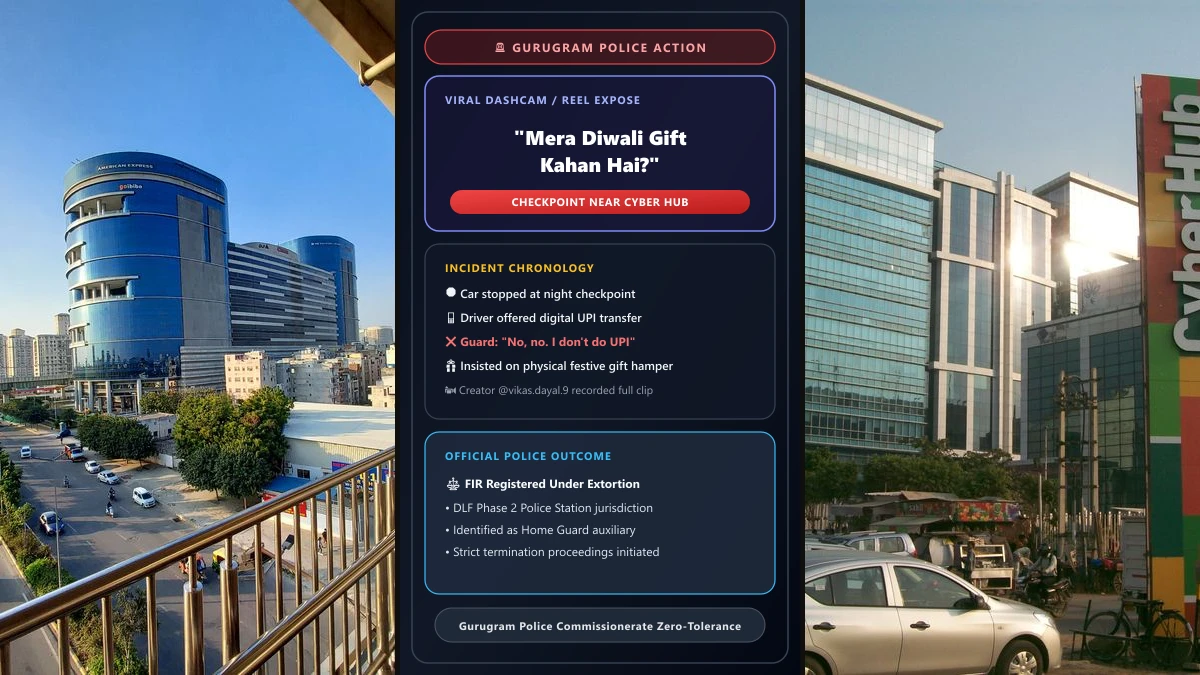
On the night of Saturday, November 7, 2026, as millions of families across Delhi-NCR concluded festive shopping on the eve of Diwali (Chhoti Diwali), automotive content creator Vikas Dayal was driving past the illuminated glass facades of Gurugram’s Cyber Hub when a routine police checkpoint took an unexpected turn.
What began as a standard vehicle stop by a uniformed official stationed behind steel barricades quickly escalated into a brazen roadside confrontation. A uniformed Home Guard personnel leaned into the driver’s window, exchanged customary holiday pleasantries, and then bluntly asked: “Mera Diwali gift kahan hai?” (Where is my Diwali gift?).
"Aap UPI le lijiye, mere paas cash nahi hai... No, no. Hum UPI nahi lete. Mera Diwali gift kahan hai?"
Rather than complying silently, Dayal—the prominent YouTuber behind the popular channel Explore The Unseen 2.0—kept his camera rolling. The ensuing two-minute exchange captured an unnerving masterclass in bureaucratic coercion, the strategic avoidance of digital audit trails, and the blurred boundary between festive goodwill and extortion.
The Checkpoint Exchange: How “Goodwill” Turned into Coercion
The video, which amassed over 3.8 million views within 24 hours of being posted to Instagram and YouTube Shorts, documents the roadside conversation word for word:
- The Initial Greeting: The uniformed personnel approaches the driver-side door, confirms the vehicle’s documents, and pauses intentionally before bringing up the festival.
- The Bold Demand: Looking directly at Dayal and his sister seated in the passenger seat, the officer smiles and asks: “Mera Diwali gift kahan hai?”
- The Cashless Defense: Dayal calmly explains that he is not carrying physical currency in his wallet and offers a cashless alternative: “Sir, mere paas cash bilkul nahi hai. Aap apna phone nikaliye, main UPI transfer kar deta hoon.”
- The Digital Refusal: Aware that a Unified Payments Interface (UPI) transaction creates an immutable, timestamped bank trail linked directly to his PAN and Aadhaar identity, the personnel immediately waves his hand in refusal: “Nahi, nahi. Hum UPI nahi chalate. UPI bilkul nahi lenge.”
- The Vehicle Search & Hamper Seizure: The personnel directs his gaze toward the rear seats, spots several decorative Diwali gift hampers containing traditional sweets and silver items, and insists that the family hand one over before he clears the vehicle to depart.
Faced with an armed official blocking their path late at night, Dayal surrendered a packaged gift hamper, recorded the departure, and promptly published the unedited footage online with the dry, biting caption: “Mera Diwali Gift Kahan Hai? Happy Diwali.”
The Tactical Refusal of UPI: Anatomy of Roadside Shakedowns
For millions of commuters across India, the detail that resonated most strongly was the officer’s instant, instinctive refusal of UPI payments.
Over the past five years, India’s digital payment revolution has dismantled informal cash extraction across retail, dining, and transit. With QR codes present at nearly every roadside tea stall and fruit cart, claiming an inability to use digital payments in Gurugram—the technology and financial capital of North India—is a calculated defense mechanism:
- Elimination of Digital Forensics: A UPI transfer logs the recipient’s Virtual Payment Address (VPA), Bank Account Number, IFSC code, and precise GPS transaction coordinates. Any citizen can attach that digital transaction slip to an official grievance on the Haryana CM Window or National Anti-Corruption portal.
- Untraceable Tangible Goods: By refusing UPI and demanding a physical festive hamper containing silver items, the personnel obtained liquid value without creating an electronic audit trail. Silver gift items and corporate hampers can easily be repurposed, pawned, or gifted forward without institutional oversight.
- The Pretext of “Festive Shagun”: Checkpoint extortions frequently disguise themselves behind cultural customs (“Bhaiya, Diwali ka kharcha toh banta hai”). By framing extortion as traditional holiday bakshish (festive tipping), corrupt personnel attempt to disarm drivers psychologically, making them feel petty or ungenerous if they resist.
The Legal Fallout: BNS Section 308(2) & Gurugram Police Action
As public fury mounted across Reddit’s r/gurgaon, X, and Instagram, senior leadership within the Gurugram Police Commissionerate initiated rapid damage control.
Within hours of the clip circulating across national news channels, Gurugram Police issued an official clarification identifying the accused individual not as a regular Haryana Police officer, but as an auxiliary Home Guard volunteer deployed under the DLF Phase 2 Police Station jurisdiction:
- Criminal FIR Registered: Authorities registered a First Information Report (FIR) under Section 308(2) of the Bharatiya Nyaya Sanhita (BNS), which covers the offense of extortion and carries a statutory penalty of rigorous imprisonment.
- Service Termination Initiated: Gurugram Police confirmed that departmental communications had been dispatched to the Commandant of the Haryana Home Guards, recommending immediate dismissal from service and permanent blacklisting.
- Official Statement on Zero-Tolerance: Gurugram Police stated: “The video circulating on social media regarding improper conduct near Cyber Hub has been taken under strict cognizance. Corruption, extortion, or harassment of motorists under the guise of festive checks will not be tolerated. Strict criminal proceedings have been initiated.”
The distinction between regular police officers and Home Guards highlights an administrative vulnerability in municipal law enforcement. Home Guards in India operate as auxiliary voluntary forces called upon to assist local police during festivals, VIP movements, and peak traffic hours. Often receiving daily stipends rather than permanent salaries or pension security, auxiliary personnel frequently lack comprehensive institutional oversight, creating fertile ground for checkpoint exploitation.
The Internet Reacts: Dashcams, Outrage, and Civic Resistance
The comment sections across Dayal’s social channels quickly transformed into a public ledger of commuter grievances, with thousands of NCR residents sharing identical experiences at roadside checkpoints:
“The moment he said ‘UPI nahi chalate’, he knew exactly what he was doing. Digital India is the biggest nightmare for corrupt officials because cash leaves no fingerprints.”
— Rajat Malhotra, Gurgaon tech professional via X
“Kudos to Vikas Dayal for staying calm and recording everything. If an ordinary commuter without a large social media following had done this, they would have been slapped with five bogus traffic challans on the spot.”
— u/ncr_commuter, viar/gurgaon
“This isn’t ‘Diwali greetings’—this is straight-up highway robbery in uniform. Asking for a gift while holding a police baton at a checkpoint is criminal coercion.”
— Ananya Sengupta, legal advocate via Instagram
Netizens also pointed out the vital protection offered by in-cabin dashcams and mobile video evidence. In previous decades, an individual motorist’s complaint against checkpoint extortion remained an unwinnable “word against word” dispute. Today, high-definition dashcams and live smartphone recording have created public transparency, forcing police departments to act swiftly when visual proof surfaces online.
Broader Resonance: Where Festive Tradition Ends and Extortion Begins
In northern India, Diwali has historically been accompanied by a tradition of voluntary tipping (inaam or shagun) to municipal sweepers, domestic workers, delivery partners, and security guards who perform demanding manual labor throughout the year.
However, the Gurugram checkpoint incident starkly exposes what happens when voluntary cultural gratitude is hijacked by state power. When an armed officer or auxiliary guard holding the legal authority to detain motorists, seize vehicles, or issue heavy fines asks for a “gift”, the interaction is not a request—it is an implicit threat.
By recording the confrontation and refusing to normalize festive checkpoint bribes, Dayal catalyzed a necessary public debate on police accountability. As festive checking continues across the National Capital Region, the incident stands as a potent precedent: citizens are no longer accepting intimidation disguised as holiday cheer, and the public lens is recording every move.