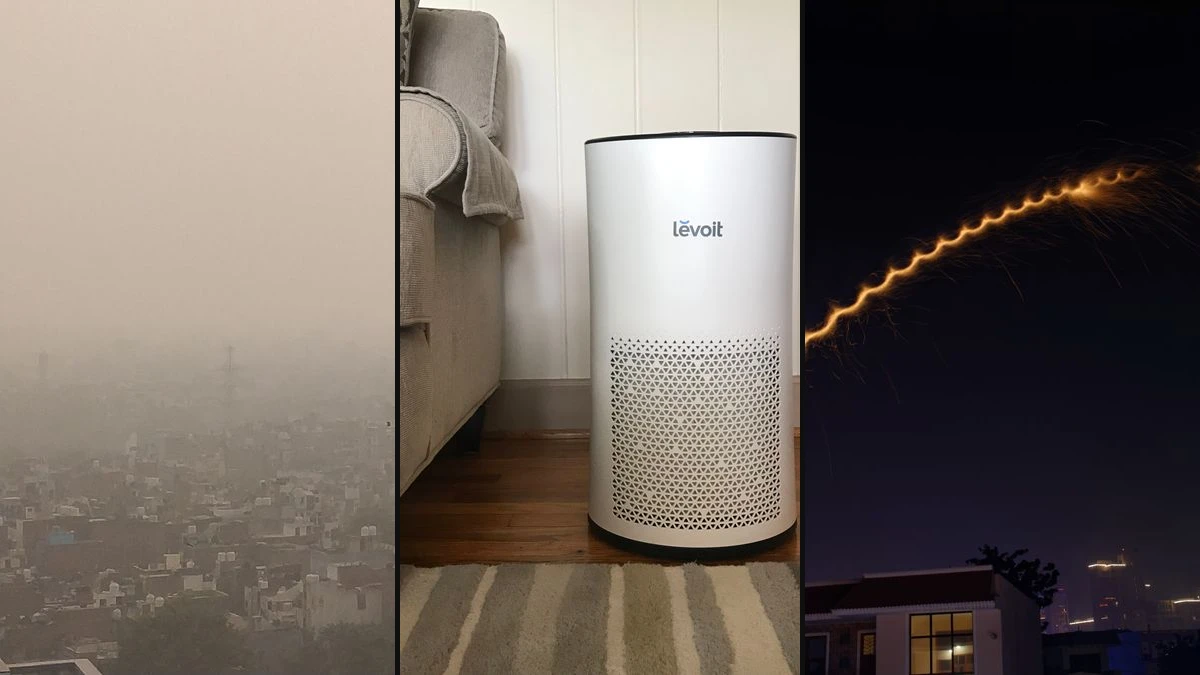
When the sun struggled to pierce through a yellow, sulfurous blanket of toxic smog across the National Capital Region on Monday morning, November 9, 2026, millions of Delhi residents awoke to a familiar, suffocating ritual: burning eyes, raspy throats, and a metallic tang on the tongue.
Yet, as citizens reached for their smartphones to check the air quality index before sending children to school or commuting to offices, what they saw ignited a firestorm of consumer panic and intense public debate.
On official government monitoring portals maintained by the Central Pollution Control Board (CPCB), the headline city-wide 24-hour average AQI stood at a grim 376, categorized as “Very Poor.” But on hyperlocal community sensor networks, commercial air quality apps like AQI.in, and smart indoor air purifier readouts across residential apartments in South Delhi, Rohini, and East Delhi, the numbers told a vastly more terrifying story.
During the peak midnight hours following Diwali celebrations, instantaneous particulate matter readings had not merely entered the severe zone—they had literally maxed out the sensor thresholds, with localized indices briefly rocketing past 1,300 to 1,500.
“The needle didn’t just move into the red; it completely broke through the top of the chart,” posted one East Delhi resident on X, sharing a screenshot of an indoor sensor reading 999+ while the room purifiers roared at maximum fan speed. “How can the official bulletin claim 376 when anyone with two lungs knows the air outside is toxic chemical soup?”
The Data Divide: 24-Hour Mathematical Smoothing vs Real-Time Poison
The stark discrepancy between official bulletins and citizen experiences highlights a structural debate that re-emerges every November across urban India: how air pollution metrics are calculated and communicated to the public.
- The Official 24-Hour Rolling Average: The CPCB’s national Air Quality Index operates on a 24-hour time-weighted average designed to prevent transient spikes from skewing long-term epidemiological data. While this methodology follows international scientific standards, it mathematically dilutes acute, short-duration pollution surges—such as the massive release of heavy metals, barium nitrates, and fine PM2.5 particles between 8 PM and 2 AM.
- The Reality at the Ground Level: Despite the smoothing algorithm, more than 20 official monitoring stations across Delhi crossed into the “Severe” category (AQI above 400). North Delhi’s Burari Crossing recorded the capital’s highest official reading at 441, closely followed by Vivek Vihar at 437 and Delhi Technological University (DTU) at 434.
- Instantaneous Exposure Spikes: Low-cost optical particle counters deployed by neighborhood residents and private tracking networks measure real-time concentrations at 1-minute intervals. During peak firecracker bursting, raw PM2.5 concentrations in narrow residential streets soared past 850 micrograms per cubic meter—more than 56 times the World Health Organization’s safe 24-hour exposure guideline of 15 µg/m³.
Panic Buying on Quick-Commerce: The Great Purifier Rush
By mid-morning on Monday, the atmospheric emergency translated into an immediate commercial scramble across retail channels and quick-commerce delivery platforms.
On ultra-fast delivery apps including Blinkit, Zepto, and Instamart, replacement HEPA filters and portable air purifiers from brands like Philips, Coway, and Xiaomi sold out in dozens of dark stores across Greater Kailash, Vasant Kunj, Dwarka, and Noida Sector 62 within minutes of inventory restocks.
Electronics retailers in major commercial centers reported massive lines of anxious customers seeking high-capacity room units:
“We had families buying two or three purifiers at once—one for the master bedroom, one for the kids’ room, and one for elderly parents,” said a store manager at an electronics outlet in South Extension. “People aren’t looking at discounts or brand preferences anymore; they are just asking, ‘Does it have a True HEPA H13 filter, and can I take it home in my trunk right now?’”
The run on air filtration extended to personal protective gear, with N95 and N99 respiratory masks experiencing their sharpest sales surge since the height of the winter smog crisis last year.
Hospitals Report Pediatric and Geriatric Respiratory Surge
While consumer tech flew off shelves, pulmonary departments across the capital began bracing for the predictable medical fallout. Senior physicians at major government and private healthcare facilities—including AIIMS, Safdarjung Hospital, and Sir Ganga Ram Hospital—reported a 25 to 30 percent jump in outpatient visits for acute respiratory distress, severe bronchospasms, and chronic obstructive pulmonary disease (COPD) exacerbations within 24 hours of Diwali night.
Medical specialists cautioned that while healthy adults experience eye irritation and dry coughs, the microscopic size of PM2.5 particles allows them to bypass the upper respiratory tract’s natural filtration, penetrating deep into the alveoli and entering the bloodstream.
“When particulate concentrations exceed 400 or 500, even brief outdoor exposure triggers systemic vascular inflammation,” warned a senior pulmonologist. “For asthmatic children and senior citizens, breathing air of this toxicity is equivalent to directly inhaling the smoke of 20 to 25 unfiltered cigarettes in a single afternoon.”
The Winter Trap: Meteorology and the Civic Deadlock
Compounding the crisis is northern India’s unforgiving seasonal meteorology. In early November, post-monsoon wind speeds across the Indo-Gangetic Plain drop precipitously to near-calm levels. As night-time temperatures plunge, a meteorological phenomenon known as thermal inversion creates a dense atmospheric “lid” close to the ground, trapping vehicular exhaust, industrial emissions, construction dust, and festive combustion products within a stagnant shallow boundary layer.
As citizen groups, environmental advocates, and resident associations demand immediate enforcement of anti-pollution protocols—including mechanized road sweeping, anti-smog guns, and strict construction moratoriums—the November 9 surge has underscored a painful reality for Delhi-NCR: clean air can no longer be treated as a seasonal inconvenience.
In a metropolis where breathing requires tactical calculations, air purifiers, and real-time sensor scrutiny, millions are left confronting a stark question: how many more winters can the capital afford to hold its breath?