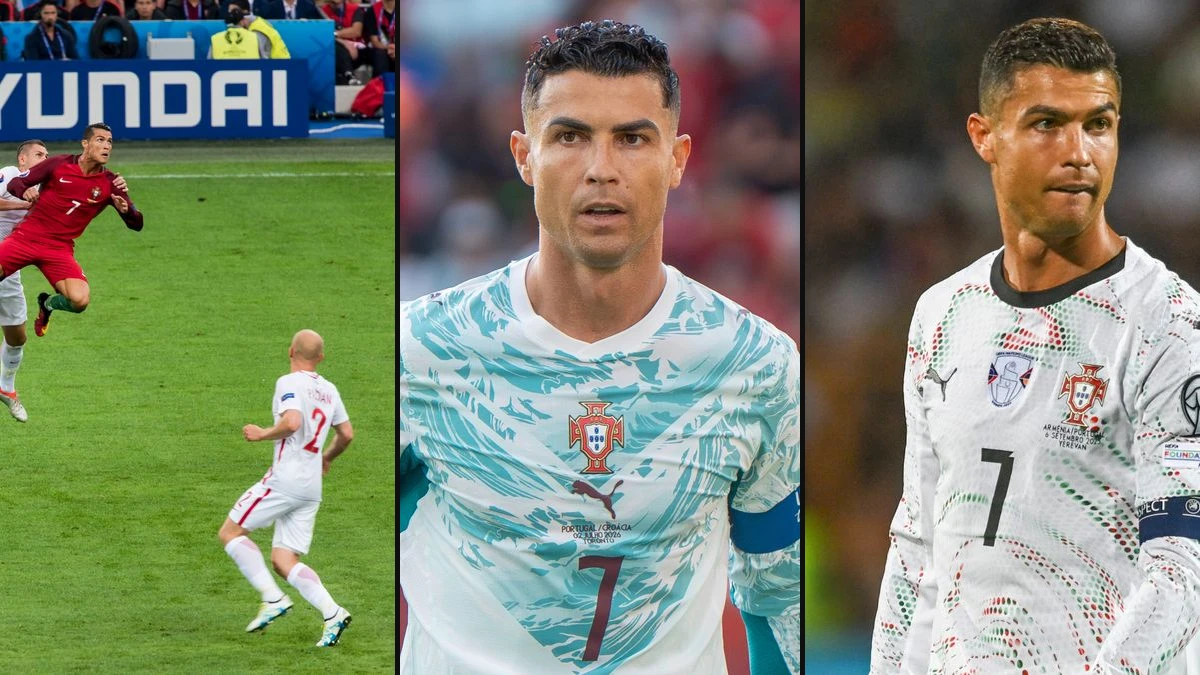
An era that defined modern international football has officially drawn to an emotional close. In a heartfelt video message shared with his record-shattering 640 million followers on Instagram, Portuguese captain Cristiano Ronaldo formally announced his retirement from international football, drawing the curtain on a peerless 23-year journey representing A Seleção das Quinas.
Sitting before the camera in an intimate, unvarnished farewell address, the 41-year-old icon delivered the words that millions of football supporters across Lisbon, Funchal, London, Riyadh, and worldwide had both anticipated and dreaded: “To the Portuguese people, the day has come for me to hand back the No. 7 shirt of our national team… A journey that began in August 2003 and changed my life forever has come to an end.”
The announcement ignited an instant global tremor across social feeds, pulling in millions of views within minutes as teammates, former managers, and generations of fans flooded the post with heartfelt tributes to the most prolific international goalscorer the men’s game has ever witnessed.
The Math & Benchmark Statistics: 23 Years in Numbers
When Cristiano Ronaldo first pulled on the senior Portuguese jersey on August 20, 2003, coming on as a halftime substitute for legendary playmaker Rui Costa in a friendly against Kazakhstan under Luiz Felipe Scolari, European football was an entirely different world. Over the twenty-three years that followed, Ronaldo transformed Portugal from an occasional dark horse into an established international powerhouse.
The statistical benchmarks left in his wake read like a compilation of impossible milestones:
- 234 Senior International Caps: Ronaldo stands alone as the most-capped men’s international player in history, surpassing Kuwait’s Bader Al-Mutawa (196 caps) and leaving contemporary rivals far behind.
- 146 International Goals: Averaging more than 0.62 goals per game across competitive qualifiers and major tournaments, he shattered Ali Daei’s historic record of 109 goals and established a benchmark that sports statisticians project may stand for over half a century.
- Major Tournament Silverware: Ronaldo spearheaded Portugal to their maiden major international trophy at UEFA Euro 2016 in Saint-Denis, followed by victory in the inaugural 2019 UEFA Nations League on home soil in Porto.
- Longevity Across Six Decades of Competitions: He is the only player to have scored in five distinct FIFA World Cup tournaments (2006, 2010, 2014, 2018, 2022) and holds the record for most European Championship appearances (six tournaments spanning 2004 to 2024).
From Teenage Tricky Winger to Lethal Box Poacher
To understand the sheer magnitude of Ronaldo’s 23-year international tenure, one must examine the profound tactical evolution that enabled him to perform at the pinnacle of international competition into his forties.
In his early international years during Euro 2004—where teenage tears flowed following the heartbreaking final defeat to Greece in Lisbon—Ronaldo was an explosive, direct winger characterized by blazing acceleration, relentless stepovers, and dramatic flair along the touchlines. His physical output relied on raw speed, rapid changes of direction, and acrobatic aerial duels.
As natural biological pacing caught up in his thirties, Ronaldo underwent one of the most calculated tactical transformations in modern sports science. Transitioning from wide areas into a ruthless central striker, he minimized extraneous off-the-ball running while maximizing penalty-box efficiency. Biometric data from his later Portugal campaigns revealed that while his total ground covered per 90 minutes adjusted to roughly 9.1 kilometers, his explosive high-intensity sprint bursts remained in the top decile among international forwards.
By employing strict polyphasic sleep protocols, personalized cryotherapy recovery, and hyper-calibrated nutrition, Ronaldo preserved the muscular power required to leap 78 centimeters off the turf, terrorizing center-backs with bullet headers well past the age when his peers had moved into television commentary or coaching.
“Handing Back No. 7”: The Internet Reacts Across the Globe
The news of Ronaldo’s international retirement triggered an avalanche of reaction across the sporting universe. Within four hours of upload, the Instagram farewell video racked up over 35 million plays and more than 6 million likes, with fellow sporting icons, world leaders, and supporters sharing their tributes.
“You changed Portuguese football forever. An entire generation grew up believing Portugal could beat anyone because you were on the pitch,” wrote one supporter from Porto. A fan from Manchester reflected: “I was 10 years old when he made his debut in 2003. I am 33 now with two children of my own, and Ronaldo was always there in the red and green. Football will never feel quite the same.”
Teammates past and present also shared heartfelt words. Portuguese midfield maestro Bruno Fernandes commented: “An honor of a lifetime to share the pitch and battles with you, captain. You made dreams reality for our entire country.” Former Portugal boss Fernando Santos, who managed Ronaldo through the historic Euro 2016 triumph, added in an official Portuguese Football Federation (FPF) release: “Cristiano didn’t just play for Portugal; he carried the soul of our nation on his back for twenty-three unforgettable years.”
Passing the Torch to Portugal’s Golden Generation
Ronaldo’s decision to step aside comes at a moment of deliberate grace. Rather than lingering past his welcome, the veteran captain leaves the national squad in exceptionally capable hands. With emerging world-class attackers like Rafael Leão, Gonçalo Ramos, João Félix, and Vitinha entering their prime, Portugal possesses one of the deepest offensive rosters in world football.
In his farewell remarks, Ronaldo emphasized his complete confidence in the younger cohort: “The shirt is being handed back, but the pride remains eternal. Portugal is in extraordinary hands, with hungry young talents who will continue elevating our flag to the highest podiums of the world.”
By formally retiring his international status, Ronaldo also settles months of feverish media speculation concerning whether he would prolong his national team run into the 2026 World Cup in North America. While his club career at Al-Nassr continues, his international chapter concludes on his own terms—as a national hero, a European champion, and undisputed king of international football.
For twenty-three years, the sight of the No. 7 jersey sprinting out of tunnel tunnels from Lisbon to Berlin was a constant in the lives of global football fans. Today, that jersey rests among the immortals.